Synchronicity


My visit with Miss Lucie went well. She knew me! You never know, and you take what you can get. But, she knew me, and the time passed as though we had visited the weekend before. The woman is a blessing. My lips, upon her forehead, came away softer.

Dinner with a friend, after an awkward embrace accompanied by pat excuses, morphed into my first dinner alone within the confines of a restaurant. It felt as I had imagined it would. I read, I ate, I left. End of story.

Yesterday was a gift from God, a teasing reminder of days to come. Cool breezes warmed easily on the kiss of a winter sun, allowing me to complete my tasks in my shirtsleeves. I pinched pansies, planted amaryllis, and mowed my lawn. Later, moisture tinged breezes urged me to fold my arms as I observed meat grilling under a waning sun.

Monday dawned on an unexpected rain, and hope. I checked in on a friend whose absence worried me. His response reminded me of both, the ease and importance of expression. An arm outstretched reminds another of his worth, and he, in kind reaches out. Such is synchronicity…

© Copyright 2007-2009 Stacye Carroll All Rights Reserved

Oh, My Darlin’…


“You wait!” A familiar sneer leant my mother’s words an equally familiar tone of acridity. “You wait! You’ll wish you had this time back! Time moves faster the older you get. Why, at my age, a year goes by in a blink of an eye.”

As a kid, who had probably just bemoaned a yawning three week wait until Christmas, her admonition had no more effect than her frequent wishes for my future.

“I hope you have children, and I hope they cause you just as much trouble as you’ve caused me.”

As it turned out, she was right, on both counts.

I have heard the month of January described as meaningless after the hustle and bustle of a holiday season that now seems to span several months. There is, of course, an introspective aspect to January, coming as it does, after weeks of economic, gastronomic, and even alcoholic depravity.

New Year’s Day dawns on millions of hung-over, antacid-swilling Americans, who greet the day holding a television remote control. Football-filled hours pass in a semi-upright position, interrupted only by the odors of foods said to be infused with magic powers on this day, and this day only. More often than not, it is while we are pushing collard greens around the perimeter of our plate, that someone floats the topic of New Year’s resolutions. As we anticipate finally being able to access a beer without encountering a well-maintained eyebrow raised by the “time police”, we attempt to discern a recognizable image in the smattering of cornbread crumbs stuck in gravy remnants before answering.

And, no matter the answer, we finally manage to pull from the refuse that is our dinner plate, one thing is sure; by January thirty-first we will have forgotten it. This is the stuff of January.

Recently, though, I’ve discovered other reasons to mark January.

January is the month of the Clementine. In case you are not familiar with this delectable nugget of sugary citrus, a Clementine is cousin to the tangerine. A friend tried, for years, to sell me on their merits, but to my discerning eye they appeared nothing more than a miniature tangerine at twice the price. I couldn’t imagine anything about them being worth double the money…until my son tasted them.

Usually imported from Spain and neighboring regions, these tiny, orange morsels are sold almost exclusively in crates. This feature originally, prohibited me from buying them. This year, after tasting one provided by my friend, I decided to chance unloading a crate of citrus on a family usually partial to meatier fruits such as apples, pears, and melons. Within days, my son was urging me to return to the store for another crate, and when I tasted one, I understood why.

That was three crates ago, and on Saturday, I carefully placed one of the last three available into my grocery cart. Clementine season is winding down. We’re treating this crate as though it will be our last, because it just might be.

This weekend, I discovered another reason to mark the passing of January. My Christmas cacti, inaccurately named as they begin blooming just after Thanksgiving, are waning. I have, over the years, collected a virtual grove of cacti by taking advantage of post-holiday plant sales. At present I nurture eight, in varying shades. This year, for the first time, all of them bloomed.

My grandmother raised Christmas cacti, and I loved one of them, especially. It was at least two feet in diameter, and bloomed in a lovely, deep, shade of pink. Visits to her house were warm, due in part to her attention to the thermostat, but also because of our shared interests. She knew I loved plants, and she loved to share. Every time I visited, she pinched off shoots of any plant I admired, urging me to root them. And, I did.

Today, my largest Christmas cactus, started as an offshoot of the one I so admired, measures over two feet in diameter. She is old. There are unattractive striations upon her leaves, and yet she blooms, gloriously, year after year. When others tease, putting out buds that never come to full fruition before the foliage shrivels; she blooms, and blooms, and blooms. I fertilize her, in warmer months. I water her, judiciously at first, until the buds begin to squeeze from her succulent fronds, whereupon I strengthen her by plying her with liquid. And she responds to my ministrations, year after year, after year.

Withered blooms fell into my watering can yesterday. The show is nearly over. As I looked around the sunroom, I enjoyed, possibly for the last time, each and every bloom; bright pink, salmon red, and white, with just a trace of pink lining each petal.

And I marked January, wondering where the time had gone.

© Copyright 2007-2009 Stacye Carroll All Rights Reserved

Saturday Morning

The warm sun and gracious breezes of yesterday are gone. The morning dawns on rain; a reminder to be careful what you wish for….

I’ve sat here for too long, as per usual. So many distractions, so much ether-noise. I’m contemplating creating a net-free day; just one day, every week, during which the rolling chair in my office is allowed to grow cold. I’m warming to the idea.

I prefer lazy Saturdays. Yawning days upon which I can paint whatever vista my mind creates. Today is not one of those days. After struggling to bring some semblance of order to my domicile, I will pull on my warmest athletic clothing and accompany my son to his basketball game. We’ve had fun this year. We are winning, due in large part to my son’s ability. Success breeds fluidity.

A more expansive frame of mind encouraged me to contact a friend and arrange a dinner date for later this evening. As happens so frequently, now that the time is upon me, I consider offering my regrets. But I won’t. I’ll go. We’ll meet in the parking lot, and exchange the usual feminine greetings, or perhaps commiserate about the weather. Once inside, we’ll sit on opposite sides of a highly burnished wooden table and scan the crowd with full knowledge that we are miles from familiar faces. The menu will provide a private moment in which to compose our made-up faces while we flip through a mental tickler file of conversation topics until a particularly savory offering captures our attention, bringing us back to the task at hand. I’ll consider ordering something fatty and delicious, but I’ll give a cursory look at the column featuring soups and salads. I’ll make a choice to keep in my back pocket until time to order, when I’ll encourage her to choose first. My choice will be incumbent upon hers. After all, if her attempts at conversation are punctuated by forkfuls of vinegar-spiked, leafy greens, a beefy morsel won’t rest easily upon my palate.

I was reminded, this week, of the psychological benefits of good works. Today, I am returning to the nursing home. The hospice is housing four patients there. I will visit those I can find. Ms. Lucie is still there. I am looking forward to seeing her. I wonder if she will remember me. Of course, she rarely knew me when she saw me every week, so the question seems a little ridiculous. One the other hand, it really doesn’t matter. It doesn’t seem important to her that she know who you are, it is only important that you are, and that you are there. I never left her without a smile. I’m looking forward to wearing one today.

© Copyright 2007-2009 Stacye Carroll All Rights Reserved

Biscuits


I never mastered the art of biscuits.

Though she didn’t do it very often, my mother made excellent biscuits. She called them Angel biscuits. Feeding a family of my own, I googled the recipe, and tried it. My children, whose exposure to sports was limited to the southern mainstays of football and baseball, exhibited an unexpected knowledge of hockey in describing an appropriate use for these biscuits.

My father enjoyed bread with dinner but, more often than not, his yen was satisfied by two slices of “Colonial” white bread riding one side of his generously filled plate. The rest of us ate breadless, and the blessing does not go unrecognized.

Holidays were marked by “dinner rolls”, usually purchased from Rich’s bake-shop. I remember them as small, delectable, little fluffs of bread. I probably could have eaten my weight in them, but the napkin lining the bread basket was carefully secured after the first offering, and my father’s hand was the only one allowed a second chance.

To my mind, the pièce de résistance of the roll kingdom measured a mere finger-width, and was only offered as an accessory to a bucket of Kentucky Fried Chicken. One of these, cradling a dollop of gravy, and I forgot all about the chicken. Long ago, these rolls went the way of Rich’s bake-shop, replaced, of course, by biscuits.

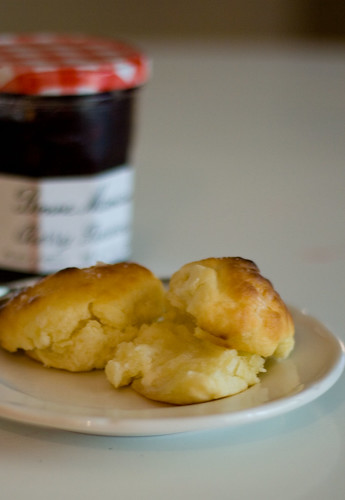
Occasionally, and usually at breakfast, my mother rapped open a can of biscuits. My father seemed satisfied no matter what form of fiber sat upon his plate. I, however, found canned biscuits an unsatisfactory fabrication of the real thing. No amount of grape jelly transformed this pig’s ear into a satin purse.

My former husband was raised in the tiny town of Jefferson, Georgia, by a mother who knew her way around a southern kitchen. And while he never complained about the dinners I fashioned from the tins and boxes of my youth, he moved canned green beans from one side of his mouth to the other, as he told stories of bigger, greener beans, slow-cooked on the back of a stove for hours, and biscuits, used to sop up the “pot liquor”.

He was there when I attempted to recreate my mother’s angelic recipe, graciously refusing to lend his voice to the discussion of ice-hockey, choosing instead to described biscuits the way he’d come to know them; large squares, cut from a single slab of dough. It became my mission to uncover this long-held culinary secret.

Viola Carroll was a formidable woman. Striated skin, hanging from space once occupied by her tricep, spoke of former girth. She was tall, a good six inches taller than I, and vocal. If she thought it, she said it; and, this knowledge, alone, was enough to put me on my best behavior. I dressed, before we left, in my most becoming casual outfit, in an effort to quell her tongue. Viola expected a woman to be “dressed”.

Our arrival was always met graciously, as Viola went for her purse. Viola always needed something from the grocery store. She gamely folded her generous frame into the bucket-seat of my aged Toyota wearing a look of anticipation heretofore only seen on a canine head hung from a car window.

As we bounced between traffic lights, Viola steadied herself upon a black, vinyl handbag boasting a faux-gold snap.

“I like yowah little cah, but this heah road sho is bumpy!”

Even now, the memory of those words brings a smile to my face.

Our foray of the local discount grocery store complete, Viola demonstrated, for me, the artistry of southern biscuits. They were, indeed, carved from a single slab of dough which she manipulated between country-sized hands, for several minutes, before slamming the mass onto an unsuspecting jelly-roll pan. A large, well-worn, butcher’s knife quickly separated the colorless blob into generous squares before her hands bounced the sides into shape. The result was toasted to a golden hue on top, leaving the middle ethereally transparent. As the fibrous mass melted upon my tongue, I knew nothing I could conjure would recreate that kind of bliss.

Fortunately, for me, there was “Bisquick”; a couple of cups of powder, poured from a gaily-colored box, mixed with water, and voilà, biscuits! Following, Viola’s example, I slammed tablespoon-sized blobs onto an unsuspecting jelly-roll pan.

Today, on the rare occasion I venture to place biscuits on my southern dinner table, I must first remove them from a frozen, plastic bag. I understand the result is every bit as satisfying as my mother’s Angels, and Viola’s squares, especially when dunked in yellow syrup.

© Copyright 2007-2009 Stacye Carroll All Rights Reserved

Catharsis


Anti-depressants helped take the edge off during the divorce. The adjunct prescription for sleeping pills was suggested by my doctor, from whom sympathy, upon hearing my story, literally oozed. It was what I needed at the time.

Not a big fan of sleep, I never finished the first bottle of sleeping pills, and, given the current reports of drug-supported, sleep-walking drivers, I am grateful.

The anti-depressant, however, became a mainstay. During the euphoric period, which lasted several months, I bought a car, quit my job, applied to college, and moved back to Atlanta. I engineered, for myself and my children, a new start.

And, we made it work. I am now employed by a good company, making a good living that supports a nice lifestyle in a bustling metropolis filled with opportunity. Current economic challenges aside, my older children are thriving in their new capacity as masters of their own destiny.

I met a man here, whose capacity to embrace my family did more to ease his way into my heart than flowers or pretty words. We raise my youngest son together, and Roger relishes the experience as though he was born to it. Shane attends the best public schools available and participates, successfully, in sports programs, year-round.

Several months ago, as I reflected upon our successes, I realized the folly of a person in my position ingesting mood-altering chemicals. It didn’t appear as an epiphany. It wasn’t an “Ah-hah” moment. It was, simply, a decision.

Unwilling to work without a net, I refilled my prescription a final time, tucking the unopened envelope into a drawer, where it remains.

And, I’ve learned a lot.

The first lesson came quickly, within weeks of my “sobriety”. While talking with a friend on the telephone, I heard joy in my laughter, and a lightness in my voice. Unshed tears sat close, in the corners of my ears, ready to flow at the first sign of poignancy. Babies, in my absence, had, somehow, grown sweeter, and seniors more enjoyable. I realized that while I hadn’t felt much pain for many years, neither had I appreciated wonder, small wonders; a frolicking puppy, a burgeoning tulip, a majestic sunset, a single word, chosen for its capacity to reach my heart.

Of course, the day did come when even my newfound joy wasn’t enough to warm the cockles of my heart. Hours usually pass before I awaken to the feeling. The day dawns, like any other day, and I go about my routine, until I notice my plodding footfalls, my listless speech, and bland affect. A look inside reveals murky darkness. Early on, the view alarmed me, setting in motion a mental slide-show, in hopes of discerning a cause; an event, a person, an unpleasant task, a caustic conversation, a disturbing memory. Failure, on most occasions, to uncover a culprit, qued-up a series of lectures I have received over the years, heralding the advances of modern medicine and my obligation to partake of its offerings. These practitioners pass around the word “organic” as though it were a virtual “Get Out Of Jail Free” card. The words mesmerize while soothing, so that the listener never even notices the acrid pill placed upon the tongue.

Organic depression can be caused by a disease process wherein key areas of the central nervous system are affected. The aforementioned doctor felt I suffer from one of these diseases, prompting his prescription. My own research supports his theory. But, I also know this; everyone has “bad” days, every one of us, even the most positive among us. I’m even willing to venture a guess that such notable positive thinkers as Marianne Williamson, Eckhart Tolle, and even Norman Vincent Peale, himself, have had a “bad” day. But, they get through it. They recognize it, they accept it, and they get through it, because, eventually, a new day dawns.

The key, for me, is to channel my feelings. I enjoy many mind-freeing activities. I love music. I do needlework while watching football. My garage is decorated by several unfinished paintings. A partially completed jigsaw puzzle fills a table in my office. I’ve clocked hundreds of miles on foot. But, my most recent revelation comes in realizing the blessing offered by the catharsis of writing.

Last week wasn’t easy. My son-in-law lost his job, and a friend, whose strength I had come to rely upon, melted into his clay feet. Life went on. I woke every day, followed my routine, and recognized my state of mind, hoping tomorrow would be better. It wasn’t.

A couple of mornings ago, I sat down to write, and has been the case, so often lately, found myself dry. But, I wrote anyway. The completed work wasn’t landmark. I hadn’t said anything important. There were no pithy phrases, or carefully concocted sentences. But, as I applied the last period to the last sentence, I smiled. A feeling of relief washed over me, as I realized a sliver of light had pierced my soul. I had discovered a new drug.

The bad days really suck. The good days make it worth it.

© Copyright 2007-2009 Stacye Carroll All Rights Reserved

Word of the Day: Mercurial


I like the word “mercurial”. It virtually dances on the tongue, fraught, as it is, with alphabetical curly-cues and trills. When I say it, out loud, I immediately flash on the word “ethereal”. On first thought, I supposed this to be an accident of pronunciation, but, in truth, there is an other-worldly essence to them both.

Mercury, dubbed Hermes by Greek mythologists, was the messenger god. He was also associated with trade, travel, and speed, as symbolized by winged feet. Early Celtic art endows him with three heads, and sometimes three penises, all of which he put to good use.

Borrowing from Norse mythology, followers of the occult assign Mercury dominion over all things magical via a circuitous route that ends, apparently, on Wednesday. The French word for Wednesday is “Mercredi”, and in Spanish “Miercoles”.

Mercury enjoyed great popularity in early Rome, inspiring many heroic stories, even though, interestingly enough, he may have lacked initiative; acting, almost always, at the behest of someone else. Apollo, Zeus, and Odysseus used him to do their dirty work, as he was well versed in the art of trickery.

He was born of an illicit union, and embraced his father’s tradition, on a grand scale, enjoying some of the most beautiful of mythological women; among them, Aphrodite, Penelope, and Chione. The fruit of these unions mirrored his duality of nature. His son, Pan, was lauded as the god of shepherds, music, and fertility. More recently, however, his image has been borrowed for use as the depiction of Satan. Another son, the beautiful Hermaphrodites, suffered gender reassignment after spurning the advances of a scornful nymph, and later, exacted his own revenge by praying that an entire body of water be spoiled, such that anyone who swam there lost his virility.

Mercurial: “2) having qualities of eloquence, ingenuity, or thievishness attributed to the god Mercury or to the influence of the planet Mercury, 3) characterized by rapid and unpredictable changeableness of mood”

I like to say the word. I like to hear it. But, recently, I have realized I don’t enjoy people who are it.

© Copyright 2007-2009 Stacye Carroll All Rights Reserved

Because I Can


My Dear JD,

The title of your diatribe put me in mind of a brilliant writer I know. Thanks for wasting no time in dispelling that notion. You got here the same way the rest of us did…you’re no better…I guess you could be worse.
You, sir, are arrogant drivel, and the picture, that you apparently could not tear your eyes away from, is of a woman, not a man; a mother, in fact. You may have deduced this yourself, had you but read, rather than scanned, the piece. Perhaps, though, you are still in the picture book phase, choosing to peruse rather than read…and that’s ok, but, you should still seek context. You’ll get more out of the pictures that way.
I am “40ish”, with a goal to be “50ish”, one day in the not too distant future, and since you read me I’m assuming you’ve realized, by now, that I am published. Given that we obviously reside on two very different planes, despite your stated geographic proximity, I hesitate to guess what you would consider “serious meat”. I would suggest, if you are truly interested, that you go back and read. You may decide for yourself. And, it isn’t necessary that you share your conclusions, I am secure, and somewhat comforted, by the fact that we will not see eye to eye.
You needn’t have shared your living on a cusp. I assumed as much very early on, as you presented prose without pictures, leaving me no option other than to read, and digest, your inanity. Judging from your description, I think it fair to say you may have found your niche.
The morphine explains a lot. Might I suggest you collect a few more chips before you waste any more time “reading” and/or writing? While it is true that some of the world’s most prolific and profound authors struggled to hold their pens upright as they created out of a chemical induced haze, it is also true that they enjoyed talent, untainted, and perhaps enhanced by, insanity. You, sir, may not be of that ilk.
I worry about very little, as I consider it a past-time affording little, or no, return, and, you, my pain-wracked detractor, are but a blip on my radar. As for being “too busy”, you caught me at a good time. I am rarely “busy” at 6:00 am, on a weekend morning. I rose with a desire to write, but, sadly, a lack of motivation or subject matter. You provided me with both, and, for that, I thank you.

Very truly yours,

S.

© Copyright 2007-2009 Stacye Carroll All Rights Reserved

Broken Circles

“Were you dumb, fat, or ugly?”

An aching silence sucked the air out of her, making it impossible to breathe.

“Which is it? Were you dumb, fat, or ugly?”

Challenge rode in, on words spoken matter-of-factly, without malice.

“For some reason you felt you had to settle. For some reason you felt like you weren’t good enough. Which was it?”

Unspoken words sparked the air, clenching her teeth, as she fought an overwhelming compulsion to cover her ears. She knew what was coming, and wasn’t sure she could hear it again.

“Were you dumb, fat, or ugly?”

She whimpered, softly.

“Who was it? Who was the bad guy?” Kindness and compassionate appreciation tinted words spoken barely above a whisper. “Was it your mother? Your father?”

Tears welled in the corners of her eyes, closest to her nose, as she felt, at once, relieved to have been given permission, and desperate to maintain composure. And, even as she battled, she recognized that the fight, too, was a problem.

Feelings rushed in on the image of her mother’s face; a scowl, a smirk, a sneer. She tried, for years, to find a smile, one smile; a smile of doting adoration, a smile of gentle understanding, a smile of quiet gratitude, a smile of genuine enjoyment. There were no smiles; not for her.

And, the words came; sharp words, strong words, words children shouldn’t speak, and can’t understand; “Idiot”, “Stupid”, “Imbecile”. And, even as they repeated, in her mother’s voice, inside her head, she wondered if, in some bizarre way, she should thank her. Did epitaphs flung at her school-aged head, in some warped way, spark an interest in vocabulary, a love of words, a need to understand? Did the constant state of confusion, mixed with a certainty of her valuelessness, spur, in her, compassion?

The vision she conjured was one of abject submission, as the picture of her mother, hate-filled sneer firmly in place, loomed down at her, hands on hips. She never understood what she did, or how she did it. She never understood the hate, the sadness, the feeling that her mother would rather be anywhere else.

With time, the feelings became memories she only had to feel on the drive down at Christmas, or Easter, or some other holiday. Placing one hand on a doorknob she’d turned thousands of times before, she held her breath, allowing her features time to compose a practiced mask of confidence, strength, and composure. She stood tall, holding her mother’s jade-infused eyes with hers, brown, and snapping, until a slumping of her mother’s shoulders, or a look of proud dismissal, gave her permission to move into the next room, where, at last, she exhaled.

The vision comes again, and, this time, she sees her own childish face; open, innocent, and needy. Questions fly around, inside her head, as she gazes down upon her own countenance.

“Why couldn’t she love me?”

“What could I have done?”

She feels the pain she felt then. She recognizes it. She honors it. She validates it.

It’s not that she hadn’t realized that she’d never had a mother.

But, it doesn’t help to be reminded.

She wonders if the scars will ever heal, as an image of her own daughter flashes across her mind.

And, she smiles through tears that never fall, secure in the knowledge that the cycle ended, with her.

© Copyright 2007-2009 Stacye Carroll All Rights Reserved

Tess


Psychiatry was, far and away, my favorite clinical rotation. It lasted for three months, and my patients were housed in the county hospital. This was when I learned that the “Psych Floor” is always on, or near, the top floor, though I have never been sure if this geography is dictated by distance from the front doors, and possible escape, or more a part of an “out of sight, out of mind” mentality.

I was jealous of other students garnering more glamorous assignments; a shelter for troubled children, a drug rehabilitation center, or a home away from home, inhabited by alcoholic men whose families had swallowed the last straw. But, that was before I realized that the Psychiatric Floor of a hospital is very much like an urban emergency room; you never know what you’re going to get, but you can be sure it will be exciting, and if you can shove your fear aside long enough, there is much to learn.

Following an orientation overseen by a frumpy, 30-something man named Mark, who favored once-expensive, over-sized sweaters, and Levi’s, over desert boots, I met with several patients whose grasp on reality was apparently restored by an overnight stay.

And, then I met Tess. Tess was a hard-timer, painfully familiar to staff and patients alike, thanks to her frequent admissions, and long stays. I learned, during morning rounds, that she suffered from schizophrenia, and, despite my training, I entered the hallway, leading to her room, with visions of Sally Field, as “Sybil”, dancing in my head.

The door wheezed as I muscled it open.

“Good morning!” This was the beginning of a verbal assault, suggested by my professor, intended to ground us both with the reality of time. I would go on.

“It’s Monday, February 17th. The sun is out, but the wind is cold!” The words were spoken loudly, with a forced gaiety I now recognize in other nurses, and earned no response.

My eyes rested, for just a moment, on the centerpiece of all hospital rooms. The bed was vacant. She sat next to the window, affording me a view of her long, brown hair, and slender shoulders, covered by a red shirt, putting me in mind of a union suit. I could have stared for as long as I liked. She was oblivious.

As I approached, I strained for a glimpse at what she was watching until, reaching her, I realized I could never see what captivated her. Her eyes were lightless.

I entered her room in this manner for three days to the same response. On day four, the wheeze of the door was barely noticeable above the sound of her mumblings. She stood, just inside the closet door, wearing a mask of complete anxiety. Her eyes, no longer lifeless, danced frenetically inside her head, lighting upon mine just long enough to reignite her terror, before jumping back into the closet.

That she felt she had lost something was apparent. I attempted to talk with her; to discover what she sought. My overtures agitated physically, sparking flailing arms, and a twisting, spittle-producing mouth that quieted mine.

I watched, helplessly, for several minutes, before mutely joining her search. Within minutes, the mumbling ceased and determined focus reshaped her features. She shadowed me, mimicking my movements. Her eyes softened, retaining their light. The corners of her mouth relaxed, and for a moment, I imagined what she might have been like; what “normal” could have been for her.

Our search failed. I left her that day feeling impotent, rattled, and very, very sad. The minute’s vision I’d held of the promise her mother must have seen, long ago, affected me. The fleeting irony of human life was spelled out, succinctly, in language I could understand, before the image, like her eyes, went dark.

© Copyright 2007-2009 Stacye Carroll All Rights Reserved

Respite


I write.

You wait.

The television plays.

The telephone rings.

The bathroom door opens, and closes, at your bidding.

And, when I’m finished, I yank the room, and my imagination, into darkness, with a single movement.

“I’m done!”

I listen, as I speak, for tell-tale signs of guilt I refuse to feel.

“Good!”

Your voice is buoyant, and your eyes, over glasses perched on the tip of your nose, welcoming, as you offer your arms.

© Copyright 2007-2009 Stacye Carroll All Rights Reserved