Game Face


I loved those Saturday afternoons. Dad was asleep by half-time, but magically, some kind of internal clock woke him in time to watch the final play. His snores leant a softness to the crowd noise and announcers’ banter.

Later, I married an avid University of Alabama football fan. He hung flags, wore his special game-day shirt, and God help you if you were misguided enough to ask him a question while the ball was in play. While watching with him, I met and fell in love with the Florida Gators.

I graduated from a school whose founder chose as its mascot the White Owl. I believe this to be the reason they were denied the right to field a football team. So, with my back to the wall, I punted, and adopted a team. For the last ten years, the only occasion upon which I’ve missed a televised Florida game, found me sitting in the stands, watching my son play.

When Shane was about four, a complete stranger approached us at a local “Chili’s” as we waited to hear the tell-tale sizzling, announcing the approach of our fajitas.

“Is this boy playing football?”

Managing to speak despite a mouth gone slack, I answered, “He’s only four!”

“Oh! Well, he’s a big boy; got offensive lineman written all over him! See ya’ in two years!”

I don’t know if he was there, but we were. Three nights a week, I hurried home from work to dress my first-grader for football practice. It had never occurred to me, during all those years of coaxing nylons up my own leg, that the experience would benefit my son. Spandex is so unforgiving….

Shane trotted gamely onto the field, as I scanned the row of peopled, nylon-covered, folding chairs, unaware that the spot I chose would, for the next several months, be designated as “my spot”. Fortunately, I chose well. Aluminum fencing, separating us from the boys, served as an adequate footrest, and my neighbor was an interesting man who, at 50, had just reenrolled in school. I found him to be somewhat aloof at first, until he explained he had no hearing in his right ear. From that point on, I leaned in to talk to him, and realized he hadn’t really been ignoring me, after all.

Six year-olds in football helmets look like Atom Ant. They just do. And there is nothing more entertaining than watching twenty-five Atom Ants run (mostly into each other), and kick, and catch. Shane learned a lot that year, and the experience inspired his father. Roger has coached Shane’s teams, in one capacity or another, every year since.

The first year with Roger at the helm was abysmal, or as we have come to call it, “a learning experience”. The team won only one game. Fortunately, it was the last one, and the fervor experienced in that triumph encouraged the parents to give him another chance.

Year two brought in new talent, and we won every game, including the county championship. Riding this wave, we beefed it up for the boys in year three. A parent/policeman arranged for her co-workers/motorcycle-club-members to escort us to the county championship. A show of bravado like this is so much more effective when you actually win the game. Instead, we suffered our first loss in two years, and the boys learned a very valuable lesson. We cleaned it up a bit, but the moral went generally like this; “Don’t let your mouth write a check your ass can’t cash.”

Shane has played football for five years now. Besides the obvious physical aspects of the game, he has benefited in many other ways. Youth sports offer a social “in”, as it introduces boys to others in their peer group they might not otherwise have met. Most importantly, though, youth sports build confidence. And, it’s not just about winning games. The confidence boosters live in the small things; a successful block at practice, the ability to run three laps around the field in one-hundred degree weather without stopping to vomit and/or cry, and being part of a group relying upon one another to complete a task. Add to this, the vision of Mom in the stands sporting the team colors, holding a sign with your name and jersey number on it, and the possibilities for positive self-esteem are endless.

Five years ago, at the age of thirteen, my nephew expressed an interest in football. He had excelled in baseball and soccer, and his parents had hoped he would continue. Football came out of left field. My sister, Laura, was especially skeptical, mostly due to the violent nature of the sport.

For the last four years, Andrew has held the starting safety position on his high-school football team, and his parents have never missed one game. Three years ago, as I sat in my pajamas, enjoying a rare Friday night at home alone, Laura called to say Andrew was playing at a local high-school just minutes from my house. I reluctantly drew on some jeans, pulled a fleece over my pajama-top, and arrived just as the third quarter began. It was my sister’s turn to don the colors, wave the pom-poms, and cheer. Her husband, too, felt his creativity enhanced by his son’s show of athletic prowess. The hats he designed for us to wear at the Championship game were comically supportive, and the cooler he lugged into the stands, packed with assorted hot beverages and warm spicy muffins. Andrew’s team ended the year as State Champions, and I have missed few games since.

Despite our living about forty minutes apart, I don’t see my sister very often. Her son’s football games provided us with an opportunity to share a passion, to laugh, and to connect. I came to relish our time.

I learned the basics of the game from watching it on television, and the nuances by watching my son and nephew play. I learned what splits are, the difference between free- and strong-safety, and how to guess a penalty call by noticing where the pretty, yellow bean-bag is thrown. It is a bean-bag, you know; a bean-bag wrapped in yellow cloth. The only flags in football are those flapping at the edges of the field.

I love American football, and my various experiences with it have left me well-versed. My son and I watch games together, and when he gushes after a particularly gutsy play, I get it. The guys at the office, misguided Georgia Bulldogs all, include me in their pre-game and post-game discussions, and through this experience I have perfected the art of “talking smack”. Ok, I pretty much had that one down already. I just aim it in a different direction now.

As they have for the last four years, my son’s team made it to the semi-finals. This year we lost, but there’s always next year. Shane made a name for himself as the best center in his age group, and his kicking coach has offered to take him to Kicking Camp at Appalachian State this summer.

The Gators won a national championship this year, and I have a tee shirt to prove it. I wear it to work on the occasional “Casual Friday” just to see those Bulldogs bare their impotent teeth.

And my Steelers won the Super Bowl! You’re thinking, “She’s from Atlanta and she’s supporting the Steelers?” Two words: Troy Polamalu.

I may know the game, but I’m still just a girl…

© Copyright 2007-2009 Stacye Carroll All Rights Reserved

"Teach Your Children"


I wasn’t sure the car would stop. The street held remnants of an earlier rain, and the ball rolling into it, was a surprise. Even more startling was the young child who followed, despite a large group of variously aged family members congregated in his driveway. As I braked, I turned to look at his family, hoping someone would see the boy, and come to his aid. Several of them turned, looking in his direction.

Blessedly, the car did stop. As I sat, allowing the child to retrieve his ball and move well clear of the car, I turned again to look at his caretakers. Some continued to watch him, while the more oblivious of the group continued talking, and laughing, and jostling; no one moved, no one called out. The boy snagged his ball, and grazed me with dark, dancing eyes, before darting back into his driveway.

My son’s presence in the garage meant he had something to tell me that wouldn’t wait.

“Mom!” His inflection confirmed my suspicion.

He burbled as we carried my things inside.

“Science class was so cool today! Mr. Patterson, you remember him, right? Well, Mr. Patterson said he’d been waiting for a rainy day to tell us this story, right?”

He freed his hands by setting a bag on the kitchen table, and began using them to bat at the puppy, whose excitement on seeing his friend come inside was just as exuberant as it had been the first time, about thirty minutes before.

“It was about a witch. Well, not really a witch. Well, she WAS a witch, but now she’s a ghost, right? I mean, it’s kinda like “Blair Witch”, but not really.”

He continued to share his story, as I moved about the kitchen. Some of his words were lost in the sounds of cans scraping along shelves and refrigerator bins opening, but I understood the crux of his story. The long and short of it, was that Mr. Patterson had set aside the business of beakers and microscopes to take advantage of a rainy day, by regaling a roomful of eleven-year-olds with his stories of adolescent close-encounters with beings from “the other side”. Unfortunately, in arriving at this decision, Mr. Patterson had forgotten his role as authoritarian. He had underestimated his own importance by sharing a frightening story with children who are directed, daily, to listen to him, and to remember every word he utters.

The next morning, I awoke to a pile of blankets on the floor beside my bed. And, somewhere in that pile, lay my frightened, sleeping son.

Shane held his cell-phone behind his back.

“Mom? Can I go to the movies with Koran?, he stage-whispered.

I asked all the usual questions; what, when, where, and gave my consent. As he ran, grinning, back to his bedroom to change, my cell-phone rang. It was Jill, mother of Alex.

“Is Shane going to the movies with Koran?”

“Yes. Is Alex?”

“Did you know that they are dropping the kids off? There will be no parents…I don’t know.”

Anger crowded my embarrassment.

“No, I didn’t know that. Let me call you back.”

I called Koran’s father, who back-pedaled furiously when questioned. I thanked him for the invitation and called Jill to tell her Shane wouldn’t be going. Her sigh spoke her relief, and I thanked her. We watch out for each other…

Laughter breached the closed door to the playroom as Shane and two boys who live next door played video games.

“Lunchtime!”, I called, imagining myself in belted shirt-dress, high heels, and pearls. June Cleaver’s got nothing on me.

Six hands vied for space under the bathroom spigot before the boys barreled into the kitchen to ham and cheese on wheat, Sunchips, and milk.

“Is there mayonnaise on this?” Ray studied his sandwich without touching it.

“Mayo and mustard.”, I answered, still in character, before resuming wiping the counters.

“Mom?” This was my son.

“Yes?”

“Do we have any vanilla stuff? You know, for the milk? They don’t drink plain milk. They like vanilla.”

I turned to find my storybook lunch decimated. Shane, his back to me, munched contentedly on the contents of his plate. To his left, two slices of discarded bread messily decorated the outskirts of a plate, while his friend held the formerly sandwiched slice of ham to his mouth. To his right, Ray had finally found the nerve to touch his food, removing all traces of mayo, leaving a slice of bread topped by mustard and ham. Both glasses of milk remained untouched.

“No, I’m sorry. And, I’m sorry you don’t like your lunch.”

“It’s okay, Mom.” Shane rushed to my defense. “It’s just that they don’t eat brown bread. They like white. And Ray doesn’t like mayonnaise, and their Mom always puts vanilla in the milk. But, that’s okay.”

That evening, the boys’ mother returned the favor, inviting Shane to dinner.

“What did you have?”, I asked on his return.

“Chicken nuggets.”, he answered. “They always have chicken nuggets. That’s what they like.”

Somehow, I can’t imagine the boys’ father braving the hazards of a drive across town in Atlanta traffic, thinking, “Mmmm, chicken nuggets!”

My sister will be late to her own funeral. This was my thought as I rested my head against the gaily colored mural adorning the wall of the local “Rio Bravo”. The trill of a cell-phone caught my attention, and seeking the sound, my eyes came to rest on a girl of about six. She flipped the phone open with one perfectly manicured hand, while the other rested on the denim-clad knee of a man I supposed to be her father. She brought the phone to her ear and turned, revealing a powdered face, featuring painted lips, carefully placed glitter, and several coats of black mascara. I’m sure my mouth fell open.

One tiny foot rocked back and forth on the tip of a stacked heel as she talked. The pink polish on her nails matched, perfectly, the hue of a sweater that clung to her board-flat chest before falling over expensively tattered jeans. Her future flashed across my eyes, leaving me with a feeling of profound sadness for her squandered childhood

Shane’s cell-phone had rung at least twenty times over the course of an hour.

“Who is that?”, I asked, irritated by the sound of my mother’s voice coming from my mouth.

“Valerie…” Shane’s voice, too, sounded stressed. He took advantage of a break in the noise to go outside, picking up a basketball on his way towards the goal.

When the offending noise began again, I picked up the telephone, intending to tell Valerie to cut back on her calls before I was forced to have a talk with her mother.

The Caller-ID bore her mother’s name and cell-phone number, but the voice on the other end of the line was Valerie’s. I made no such threat.

His efforts at whispering drew my attention.

“I know, but we’re changing plans in June. It doesn’t make sense to buy a new phone now.”

The span of his silence suggested his wife’s increasingly shrill voice.

“He can use my old phone.” These words were louder, more forceful, in keeping with a man with a plan.

Another silence ensued, and when conversation continued, it went on for some time, though he spoke few words.

Later, he visited the office across from mine.

“My son lost his phone.”

“Can’t he just use your old one until we change plans in June?” , his sensible friend asked. “Buying a new phone now would just be a waste of money, because it won’t work with the new plan.”

“She wants to get him another Razor. She’s worried what his friends will think.”

His friend’s derisive chuckle spoke volumes.

“I told her we’d just use mine.”

Later that afternoon, his loquacious wife, with children in tow, came by to pick him up on their way to purchase the Razor.

“What are you doing this weekend?” I asked, as the clock ticked towards four, and our two-day pass.

“I’m taking my son to a birthday party at the Roxy.”, came the bored-sounding answer.

“The Roxy?”, I asked, incredulous. “THE Roxy? The concert hall downtown? A twelve year-old child is having a birthday party at the Roxy?”

“Yeah…it’s to make up for all the bot-mitzvahs.”

I had no answer for that.

What will become of our children? It seems every passing day presents me with another horrifying example of adults who have seemingly forgotten their role. A young child is allowed to follow a ball into a rain-soaked road in front of an oncoming car, and they watch. A science teacher, whose words are expected to form the minds of our children, spends an entire class period convincing them that witches and ghosts are not just the stuff of Halloween charades. A group of eleven year-old boys and girls are invited to a Sunday afternoon movie by parents who can’t be bothered to chaperone. A Harvard educated mother feeds her children a diet so consumed by frozen, fried chicken and vanilla flavored milk, that sandwiches on whole-grain, accompanied by organically produced milk, appear exotically disgusting. I shared a restaurant waiting room with a six-year-old whose make-up was applied more professionally than mine. A mother, apparently, never questions her daughter about hundreds of calls made from her cell phone to a boy she sees, every day, in their sixth-grade classroom. A boy’s father caves to his ranting mother, by spending money on a cell phone that will be useless in less than six months; in an effort to retain pre-pubescent social status. And, an entire concert hall, complete with seating for several thousand, is rented in honor of a twelve-year-old girl who had the misfortune of being born to Christian parents.

How long before the odds play out? Who do our children have to look up to? When did outings and fancy electronics replace structured caring and responsibility? When did children begin making decisions that affect an entire family? As they cry through smeared mascara, who will explain objectivism to our girls? What is left? What will they have to look forward to; to work towards? How will they define “special”?

© Copyright 2007-2009 Stacye Carroll All Rights Reserved

Too Little, Too Late?


I went to work at the age of fifteen, mostly in an effort to ensure that my wardrobe reflected my tastes, and of course current trends, instead of what was on sale at Sears/Roebuck. As I flipped through the racks at Lerner’s, Gloria Steinem turned the world on its ear.
I remember wondering why she had chosen to thread the earpieces of her large, tinted, aviator glasses over her hair, instead of hiding them underneath, as the rest of us did. She had to be close to my mother’s age, but instead of going every six weeks to the beauty shop for a style and set, Gloria grew her hair long, allowing the strands to drape her painted face along the line of a stylish center part. She wore short skirts and knee-high boots instead of the polyester pull-on pants and knit tops my mother favored. And she spoke, in measured, succinct tones, of the oppression of women, and their unheralded strength and value. I had discovered a hero.

The birth of my first child ignited in me, a breed of love I have never experienced before, or since. When my daughter was six weeks old, I reentered the job market, as promised, and worked for two weeks in a local department store. Coming home to two miserable females convinced my husband that our financial obligations could be met by one salary. Nine months later, I was pregnant, again. The prohibitive cost of daycare for two babies made me a stay-at-home Mom, who contributed to the family finances by caring for three unrelated children during the day.

Following a pattern set by my mother, I developed an interest in soap operas, timing my morning chores around the television schedule. As theme music began to play over the final act, I reached for the telephone, beginning a daily marathon of conversation with another mother, that ended precisely one hour before the sound of rubber crunching gravel announced my husband’s arrival home. Dinner rolls browned as he showered, and if I timed it just right, they both emerged at the same time.

Gloria, and others like her, referred to me as a “couch potato”. Soap operas and well-timed dinners had brought with them my mother’s wardrobe, and as Gloria stylishly stomped across the stage to shake Mike Douglas’ hand, I looked down at my widening, polyester draped hips. She flipped her hair back, and I self-consciously fingered the clip that tamed my un-coiffed mane. She spoke words that used to come from my lips, before my vocabulary consisted of the single syllables of my children’s picture books. And, with those words, she urged me to own my life, to shake off oppression, to look my husband in the eye and demand my right to make my mark.

Within weeks, I was dropping my youngest son at a local church daycare before the sun’s warmth had dried the dew from the grass we used to play in. My two older children were in school, and my presence, when the school bus pulled up in front of our house every afternoon, assured me that I was living “the life”, “having it all”. And, I’ve never looked back. My path has followed the course Gloria promised. I’ve risen in the ranks, I’ve padded my pocketbook, and I’ve got the big-screen TV, late-model automobile and designer handbags to prove it.

Last week, as I urged my shiny, red car down rain-slick streets in an effort to be home in time for my son’s basketball game, the radio dial came to rest on one of hundreds of satellite enhanced offerings. A young woman bemoaned the travails of working-motherhood; the pressed schedules, the unreasonable demands, feelings of inadequacy. The measured tones of a well-known, conservative talk show host filled my car, and Gloria urged my well-manicured index finger towards the dial, but before I could reach, I heard.

“Did you ever think that the reason you don’t enjoy being a stay-at-home Mom is because YOU don’t appreciate your own worth; YOU don’t think what you do is valuable? Did you ever think you may have been sold a bill of goods?”

My eyes strayed, again, to the clock in my dash; thirty minutes to game-time. I thought of my daughter, draped in polyester, passing her days in manufactured housing twenty-five minutes from the closest grocery store, standing at the bus-stop with an umbrella in one hand, and a dog’s leash in the other.

Her lack of drive has always bothered me. The decision to enroll her in classes for the gifted was not an easy one. I worried about the pressure, and possible ostracism from those who were tracked for mediocrity. I placed her, and she excelled until an older boy from the “wrong side of the tracks” bounced his seemingly permanently affixed cigarette in her direction.

Despite every intervention offered in every psycho-babble book I’d ever read, and a few I came up with on my own, she was lost to me, until an inevitable stint in state prison interrupted their courtship, as my nemesis traded his Camels for a neon-orange pant-suit.

His departure from her life took with it nearly thirty pounds. Fit and lithe, she marketed herself, again. Eric fancied himself a guitarist the likes of Jimmy Page. His black, leather jacket was expensive. His vocabulary included words like “please”, and “thank you”. His eyes sparkled over a Greek menu he was more than willing to try, and I was sold.

Six months later, when my daughter called with the news of her pregnancy I asked her in measured tones, “Are you prepared to raise this child alone?”.

“But I won’t, Mama”, was her answer.

And she hasn’t. Christopher, her husband, is a kind, calm, wise, loving father who went to work, everyday, at five-thirty in the morning. When he came home, around four, he liked to play video games until supper was ready, which he followed with a shower, and bed. Two weeks ago, the air conditioning plant in which he worked succumbed, as have so many, to financial crisis. On the day she got the news, my daughter called to tell me she would be going full-time at her former weekend job.

As I sat in my car, with eyes darting between dashboard clock and traffic light, I finally appreciated her sacrifice. I arrived home amidst a flurry of game-time preparations, and as my son went in search of yet another missing sock, withdrew my check book from my bag. Wrapping the check in a scribbled note, I handed the envelope to my over-anxious basketball star directing him to drop it in the box while I locked up.

Two days later, just as I had expected, the telephone rang and I answered to the sound of my daughter’s appreciative voice.

“You didn’t have to do that.”

“I know I didn’t. You didn’t ask for it. But I wanted you to have it, and I want you to know why.” I plopped into my office chair, rolling to the spot offering the best view through the bank of windows that comprise the opposite wall.

“You and I don’t always see eye to eye. I know I’ve pushed you to do more, be more. Today, I realized that what you have been doing is very important, and while forces outside of your control have dictated that you change your priorities, I hope that change will be temporary. That money is between me and you. I expect you to use it to meet needs left unmet by your income. But, I also expect you to support Christopher by encouraging him to get out there and find another job, so that one day soon, you can go back to being…just a Mommy. This is my way of letting you know, I get it.”

She was silent for a few moments before saying simply, and quietly, “Thank you, Mom.”

© Copyright 2007-2009 Stacye Carroll All Rights Reserved

Oh, My Darlin’…


“You wait!” A familiar sneer leant my mother’s words an equally familiar tone of acridity. “You wait! You’ll wish you had this time back! Time moves faster the older you get. Why, at my age, a year goes by in a blink of an eye.”

As a kid, who had probably just bemoaned a yawning three week wait until Christmas, her admonition had no more effect than her frequent wishes for my future.

“I hope you have children, and I hope they cause you just as much trouble as you’ve caused me.”

As it turned out, she was right, on both counts.

I have heard the month of January described as meaningless after the hustle and bustle of a holiday season that now seems to span several months. There is, of course, an introspective aspect to January, coming as it does, after weeks of economic, gastronomic, and even alcoholic depravity.

New Year’s Day dawns on millions of hung-over, antacid-swilling Americans, who greet the day holding a television remote control. Football-filled hours pass in a semi-upright position, interrupted only by the odors of foods said to be infused with magic powers on this day, and this day only. More often than not, it is while we are pushing collard greens around the perimeter of our plate, that someone floats the topic of New Year’s resolutions. As we anticipate finally being able to access a beer without encountering a well-maintained eyebrow raised by the “time police”, we attempt to discern a recognizable image in the smattering of cornbread crumbs stuck in gravy remnants before answering.

And, no matter the answer, we finally manage to pull from the refuse that is our dinner plate, one thing is sure; by January thirty-first we will have forgotten it. This is the stuff of January.

Recently, though, I’ve discovered other reasons to mark January.

January is the month of the Clementine. In case you are not familiar with this delectable nugget of sugary citrus, a Clementine is cousin to the tangerine. A friend tried, for years, to sell me on their merits, but to my discerning eye they appeared nothing more than a miniature tangerine at twice the price. I couldn’t imagine anything about them being worth double the money…until my son tasted them.

Usually imported from Spain and neighboring regions, these tiny, orange morsels are sold almost exclusively in crates. This feature originally, prohibited me from buying them. This year, after tasting one provided by my friend, I decided to chance unloading a crate of citrus on a family usually partial to meatier fruits such as apples, pears, and melons. Within days, my son was urging me to return to the store for another crate, and when I tasted one, I understood why.

That was three crates ago, and on Saturday, I carefully placed one of the last three available into my grocery cart. Clementine season is winding down. We’re treating this crate as though it will be our last, because it just might be.

This weekend, I discovered another reason to mark the passing of January. My Christmas cacti, inaccurately named as they begin blooming just after Thanksgiving, are waning. I have, over the years, collected a virtual grove of cacti by taking advantage of post-holiday plant sales. At present I nurture eight, in varying shades. This year, for the first time, all of them bloomed.

My grandmother raised Christmas cacti, and I loved one of them, especially. It was at least two feet in diameter, and bloomed in a lovely, deep, shade of pink. Visits to her house were warm, due in part to her attention to the thermostat, but also because of our shared interests. She knew I loved plants, and she loved to share. Every time I visited, she pinched off shoots of any plant I admired, urging me to root them. And, I did.

Today, my largest Christmas cactus, started as an offshoot of the one I so admired, measures over two feet in diameter. She is old. There are unattractive striations upon her leaves, and yet she blooms, gloriously, year after year. When others tease, putting out buds that never come to full fruition before the foliage shrivels; she blooms, and blooms, and blooms. I fertilize her, in warmer months. I water her, judiciously at first, until the buds begin to squeeze from her succulent fronds, whereupon I strengthen her by plying her with liquid. And she responds to my ministrations, year after year, after year.

Withered blooms fell into my watering can yesterday. The show is nearly over. As I looked around the sunroom, I enjoyed, possibly for the last time, each and every bloom; bright pink, salmon red, and white, with just a trace of pink lining each petal.

And I marked January, wondering where the time had gone.

© Copyright 2007-2009 Stacye Carroll All Rights Reserved

Biscuits


I never mastered the art of biscuits.

Though she didn’t do it very often, my mother made excellent biscuits. She called them Angel biscuits. Feeding a family of my own, I googled the recipe, and tried it. My children, whose exposure to sports was limited to the southern mainstays of football and baseball, exhibited an unexpected knowledge of hockey in describing an appropriate use for these biscuits.

My father enjoyed bread with dinner but, more often than not, his yen was satisfied by two slices of “Colonial” white bread riding one side of his generously filled plate. The rest of us ate breadless, and the blessing does not go unrecognized.

Holidays were marked by “dinner rolls”, usually purchased from Rich’s bake-shop. I remember them as small, delectable, little fluffs of bread. I probably could have eaten my weight in them, but the napkin lining the bread basket was carefully secured after the first offering, and my father’s hand was the only one allowed a second chance.

To my mind, the pièce de résistance of the roll kingdom measured a mere finger-width, and was only offered as an accessory to a bucket of Kentucky Fried Chicken. One of these, cradling a dollop of gravy, and I forgot all about the chicken. Long ago, these rolls went the way of Rich’s bake-shop, replaced, of course, by biscuits.

Occasionally, and usually at breakfast, my mother rapped open a can of biscuits. My father seemed satisfied no matter what form of fiber sat upon his plate. I, however, found canned biscuits an unsatisfactory fabrication of the real thing. No amount of grape jelly transformed this pig’s ear into a satin purse.

My former husband was raised in the tiny town of Jefferson, Georgia, by a mother who knew her way around a southern kitchen. And while he never complained about the dinners I fashioned from the tins and boxes of my youth, he moved canned green beans from one side of his mouth to the other, as he told stories of bigger, greener beans, slow-cooked on the back of a stove for hours, and biscuits, used to sop up the “pot liquor”.

He was there when I attempted to recreate my mother’s angelic recipe, graciously refusing to lend his voice to the discussion of ice-hockey, choosing instead to described biscuits the way he’d come to know them; large squares, cut from a single slab of dough. It became my mission to uncover this long-held culinary secret.

Viola Carroll was a formidable woman. Striated skin, hanging from space once occupied by her tricep, spoke of former girth. She was tall, a good six inches taller than I, and vocal. If she thought it, she said it; and, this knowledge, alone, was enough to put me on my best behavior. I dressed, before we left, in my most becoming casual outfit, in an effort to quell her tongue. Viola expected a woman to be “dressed”.

Our arrival was always met graciously, as Viola went for her purse. Viola always needed something from the grocery store. She gamely folded her generous frame into the bucket-seat of my aged Toyota wearing a look of anticipation heretofore only seen on a canine head hung from a car window.

As we bounced between traffic lights, Viola steadied herself upon a black, vinyl handbag boasting a faux-gold snap.

“I like yowah little cah, but this heah road sho is bumpy!”

Even now, the memory of those words brings a smile to my face.

Our foray of the local discount grocery store complete, Viola demonstrated, for me, the artistry of southern biscuits. They were, indeed, carved from a single slab of dough which she manipulated between country-sized hands, for several minutes, before slamming the mass onto an unsuspecting jelly-roll pan. A large, well-worn, butcher’s knife quickly separated the colorless blob into generous squares before her hands bounced the sides into shape. The result was toasted to a golden hue on top, leaving the middle ethereally transparent. As the fibrous mass melted upon my tongue, I knew nothing I could conjure would recreate that kind of bliss.

Fortunately, for me, there was “Bisquick”; a couple of cups of powder, poured from a gaily-colored box, mixed with water, and voilà, biscuits! Following, Viola’s example, I slammed tablespoon-sized blobs onto an unsuspecting jelly-roll pan.

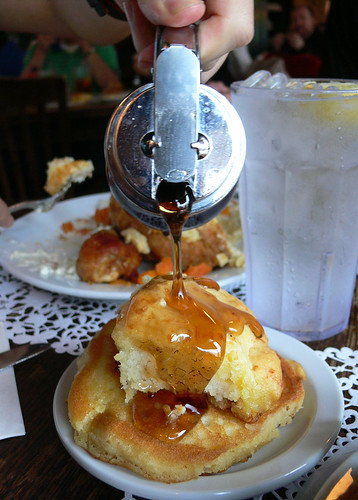
Today, on the rare occasion I venture to place biscuits on my southern dinner table, I must first remove them from a frozen, plastic bag. I understand the result is every bit as satisfying as my mother’s Angels, and Viola’s squares, especially when dunked in yellow syrup.

© Copyright 2007-2009 Stacye Carroll All Rights Reserved

Broken Circles

“Were you dumb, fat, or ugly?”

An aching silence sucked the air out of her, making it impossible to breathe.

“Which is it? Were you dumb, fat, or ugly?”

Challenge rode in, on words spoken matter-of-factly, without malice.

“For some reason you felt you had to settle. For some reason you felt like you weren’t good enough. Which was it?”

Unspoken words sparked the air, clenching her teeth, as she fought an overwhelming compulsion to cover her ears. She knew what was coming, and wasn’t sure she could hear it again.

“Were you dumb, fat, or ugly?”

She whimpered, softly.

“Who was it? Who was the bad guy?” Kindness and compassionate appreciation tinted words spoken barely above a whisper. “Was it your mother? Your father?”

Tears welled in the corners of her eyes, closest to her nose, as she felt, at once, relieved to have been given permission, and desperate to maintain composure. And, even as she battled, she recognized that the fight, too, was a problem.

Feelings rushed in on the image of her mother’s face; a scowl, a smirk, a sneer. She tried, for years, to find a smile, one smile; a smile of doting adoration, a smile of gentle understanding, a smile of quiet gratitude, a smile of genuine enjoyment. There were no smiles; not for her.

And, the words came; sharp words, strong words, words children shouldn’t speak, and can’t understand; “Idiot”, “Stupid”, “Imbecile”. And, even as they repeated, in her mother’s voice, inside her head, she wondered if, in some bizarre way, she should thank her. Did epitaphs flung at her school-aged head, in some warped way, spark an interest in vocabulary, a love of words, a need to understand? Did the constant state of confusion, mixed with a certainty of her valuelessness, spur, in her, compassion?

The vision she conjured was one of abject submission, as the picture of her mother, hate-filled sneer firmly in place, loomed down at her, hands on hips. She never understood what she did, or how she did it. She never understood the hate, the sadness, the feeling that her mother would rather be anywhere else.

With time, the feelings became memories she only had to feel on the drive down at Christmas, or Easter, or some other holiday. Placing one hand on a doorknob she’d turned thousands of times before, she held her breath, allowing her features time to compose a practiced mask of confidence, strength, and composure. She stood tall, holding her mother’s jade-infused eyes with hers, brown, and snapping, until a slumping of her mother’s shoulders, or a look of proud dismissal, gave her permission to move into the next room, where, at last, she exhaled.

The vision comes again, and, this time, she sees her own childish face; open, innocent, and needy. Questions fly around, inside her head, as she gazes down upon her own countenance.

“Why couldn’t she love me?”

“What could I have done?”

She feels the pain she felt then. She recognizes it. She honors it. She validates it.

It’s not that she hadn’t realized that she’d never had a mother.

But, it doesn’t help to be reminded.

She wonders if the scars will ever heal, as an image of her own daughter flashes across her mind.

And, she smiles through tears that never fall, secure in the knowledge that the cycle ended, with her.

© Copyright 2007-2009 Stacye Carroll All Rights Reserved

More Than A Calendar Change


I have a thing for calendars….

Every year, around this time, I struggle with which ones to hang, and which to donate to the “extra calendar pile” at the office.

It seems every charitable organization, to which I donate, sends me a calendar. Many of these, especially the ones portraying animals, are hard to resist. One year I didn’t. I hung five different calendars around my office, so that no matter which wall you faced, you were met by a furry visage, or a magnificent vista.

Last year, during a post-Christmas shopping trip, I stumbled upon a kiosk of interesting calendars in a local hobby store. I left with one for my son, featuring unusual, black and white photography, and one for me, decorated in a colorful, quilted pattern. I was enticed by the pocket at the bottom of each page, and the large, pastel-hued butterfly that adorned it. Each month was marked in a different color scheme; one more beautiful than the next. I really enjoyed that calendar.

During a spate of time, since 2004, really, when there didn’t seem to be much to look forward to, my calendars filled a New Year’s void.

The shock of that election changed me. My television went dark, and my radio presets changed. NPR could no longer be trusted. I shut off every media outlet that might remind me of America’s folly. I adopted a mindset of entrenchment. And, if ignorance wasn’t exactly bliss, it was definitely preferable to the panic, and utter embarrassment, which set upon my heart, and mind, at the sound of our president’s bumbling speech, or the sight of his “Aw, shucks” grin.

As 2008 dawned, I had a truly magnificent calendar, and a glimmer of hope, based in the knowledge, that no matter how the upcoming election turned out, one thing was certain; George W. Bush would no longer be President of the United States.

I struggled, for months, with choosing a candidate. There seemed to be so little difference between them. The feminists would have me vote for a woman, for gender reasons, alone. Patriots would have me support a former POW, based upon his years of military service, which ended over thirty years ago. Christian fundamentalists had their man, whose shining moment occurred during an appearance on Saturday Night Live. I was impressed. I would hire him as a straight man, but President of the United States?

And then, there was the tall skinny, big-eared, black guy, with the scary name.

I live in Georgia. I wish I had a dollar for every time, over the last eleven months, I’ve heard the following:

“Well, I just can’t vote for a man named “Obama”. It’s just not right!”

I assume this phrase to be uttered by those who choose their candidate based, solely, on appropriate surname…and their sports teams, by jersey color.

The feminists’ choice floundered, shrilly, when prompted for details. The patriot lost his edge, and the Christian choice threw in the towel, as did many other, less noticeable, candidates.

And, then there was one.

I began to research. I spent hours poring over internet articles. I listened to speeches, I sought highly regarded opinions, and by the time I flipped my calendar over to reveal November’s butterfly, I was content in my choice.

As is my custom, I took my son with me to our polling place. We stood, on a sun-splashed, blustery morning, in a longer than usual line of voters. We conversed with neighbors,rarely seen otherwise, and accepted the offer of a warm beverage from an excited, gray-haired poll worker.

At one point during our wait, my son scanned the affluent, monochromatic, bedroom-community crowd, and stage-whispered, “I don’t think many of these people are voting for Obama.”

I laughed, in surprise, at his insight; reminded, again that he is an old soul.

“You’re probably right!”, I began, before bending closer to him. “But, that’s ok. That’s what makes our country great, the ability to choose. We just have to hope that enough of us make the right choice.”

And, to my thinking, we did.

My television remains, for the most part, dark, but NPR has, once again, become part of my morning commute. The economic legacy, left by Mr. Bush, dampened my Christmas, and continues to spread its pall over the new year. The devastation didn’t come about rapidly, and, recovery will take some time.

My son-in-law was laid off, with a reasonable severance package, two weeks ago. My daughter has made arrangements to support her family by increasing her hours, from weekends, only, to full-time, starting this week. One of my sons has seen his hours cut back, drastically, with the warning that lay-offs could come in January. My next paycheck will reflect a ten-percent salary cut, in an admirable move, made by our administrators, to protect all our jobs.

And, while these events are somewhat disconcerting, they are not devastating. I find myself anticipating 2009 with a sense of hope, based in the fact that, despite our former misguided choices, this time, we, as a people did the right thing; we put aside petty differences, and superstition, and bias, and chose a rather unlikely leader to guide us through, what will surely be, very treacherous times. We dared to hope, we took definitive action, and we showed the world that we can change.

And, the world expelled a long-held sigh of relief…and applauded.

“How do you measure a year? In daylights, sunsets, midnights, cups of coffee…in laughter & strife. Remember the love. Measure your life in seasons of love.”
Jonathan Larson

© Copyright 2007-2009 Stacye Carroll

“Tryin’ To Get The Feelin’, Again”


I love Christmas.
I love the music, the colors, the lights, the smells, the sparkle.
I love children at Christmas; especially young children, who still carry the magic, and spread it, through the light that shines in their eyes on Christmas morning.
I love wrapping paper. One year, when I was greener than I am now, and much poorer, I fashioned wrapping paper from brown paper grocery bags, and a couple of potatoes carved into stamps. The result, when tied with red and green dyed raffia, was rustic and charming. Now, as I rifle through shelves of shiny pre-printed rolls, I prefer a thick, shiny paper that creases easily into nice sharp edges, as it covers a box.
I love Christmas baking. I do a lot of it, not just for our family, but also to give to friends, as gifts. To insure a reasonable amount of freshness, I usually start the evening of the twenty-first. Each night until the twenty-forth I cook three or four different decadent treats; storing them in canisters with sheets of waxed paper between each layer. No one is allowed to sample the goodies until our family get-together on Christmas Eve. And, I love Christmas Eve.

When my older children were very young, they complained, loudly, about the unfairness of their father and me attending holiday parties to which children were not invited. From their perch on the babysitter’s lap, they watched longingly as we left on a wave of sparkling holiday elegance. And, next morning, they plied me with questions about what we did at the party, and what kind of food was served. The actual event could, in no way, match their vivid imaginations; and I would occasionally embellish my story, as I passed out the treats I had secreted inside a gaily colored paper napkin, the night before.
I don’t remember exactly when, but at some point, I began throwing parties on Christmas Eve for my children; not children’s parties, but parties much like the ones their father and I attended, complete with real hors d’oeuvres and pretty beverages, minus the alcohol. They ate their food from Christmas china on tables covered with seasonal linens, and the candlelight danced in accompaniment to Christmas music which filled the background, softly. Most years saw several friends in attendance, as well, and, while I still brought goodies home, my children never again complained when we went to a party.
The tradition continues today. I began baking, grateful for my daughter’s help. And, when the M&M cookies refused to flatten, leaving me with something more in keeping with an M&M biscuit, it was nice to have someone to laugh with.

Christmas, this year, was a struggle. As Thanksgiving passed, I sought out the radio station playing non-stop Christmas music, and, as I always do, saved it in my presets. In years past, I listened every day to and from work. This year, I tuned my dial to this station just twice, when my son and I were out, Christmas shopping. All the songs sounded the same. There was nothing new; nothing interesting. My commute was fueled, instead, by a favorite CD or Sirius.
Most of my shopping was done online. This is nothing new, though, my approach to it was. I didn’t so much shop, as purchase, having decided on my gifts, in a very matter-of-fact way, much earlier. This proved very efficient, but much less enjoyable. In years past, as the boxes arrived, I took much pleasure from slicing them open to view what was inside. This year, the boxes remained sealed until time came to wrap them.
The day after Thanksgiving is always set aside for Christmas decorating. This year I hung the last wreath three days later. The crèche never made it out of the box, and the garland that usually drapes the fence lay, unlit, on top of a box in my garage.

I strapped on my apron on the December twenty-second, and made all our favorites, but much less of them.
Our Christmas Eve party started, as always, as 6:00 pm. In years past, as the evening wore on, I found myself tired, and looking forward to clean-up, and bed. This year, the house was quiet by 8:00, and I ended the evening with a movie on pay-per-view.
A couple of weeks ago, as I sat alone in my office, I thought about my struggle to feel Christmas. After several minutes of soul searching, I finally decided that the culprit was my commitment to frugality, in deference to a fragile economy. My decision to reign in my expenses had taken all the fun out of the holiday. Choosing Christmas gifts had become a question of money, rather than the receiver’s delight. Holiday cooking became a chore to be completed, rather than an experiment of gastronomic pleasure. My lack of spirit was evidenced by decorations that never left their boxes.
My husband, and I, used to argue about when to take down the decorations. I felt they added sparkle to New Year’s celebrations. He subscribed to an old adage, holding that Christmas decorations, lasting until the New Year, brought bad luck. We quibbled for years, and usually got them down just before the ball began to drop.
Today is December twenty-eighth, and my house is free of Christmas debris. For whatever reason, the spirit never quite arrived, and the remnants of it were just a reminder of what never was. I am not happy in the realization that money has come to play such a large part in my enjoyment of the holiday, and hope to change that in the coming year. I’ll start by saving brown paper grocery bags…

© Copyright 2007-2009 Stacye Carroll

Eleven


“Mom?” About three feet behind me, he begins to trot, in an effort to catch up. The movement, in the corner of my eye, reminds me of so many seasons of football and the characteristic way he exits the field.
“Mom, you’re lucky you’re a girl, you know that, right?” Extra effort pillows his words in gusty breaths.
“Well, I think so.” I turn and smile at him as he reaches my side.
“You want to know why?” He puffs, as we climb the cement incline leading to the book store.
“Why?” I stow my keys and check for my wallet.
“’Cause at school? All the girls have like lots of presents and stuff. I mean, they open their lockers, and there’s just all this STUFF in there, and they’re always giving each other presents, and guys just don’t do that, you know?” The extra effort required to breathe doesn’t slow his characteristically swift speech pattern.
We reach the door, which he hurries to open.
“Yeah.” I answer thoughtfully. “Yeah, I guess you’re right. Come to think of it, guys don’t really give each other a lot of presents do they?”
“So see?”
He pushes his point home, as a coffee table book featuring a shiny, red, vintage car catches his attention.
“You’re lucky you’re a girl.”
The last word disappears between the pages.

“Mom?”
I insert one finger into the loamy soil supporting a prized cactus before lifting the watering can.
“Yes?” I watch the pot fill.
“Would you still love me if I was gay?”
I remember to take a breath, before continuing my perusal of the plant.
“Sure, honey. You know, there’s nothing you could do that would change the way I love you.”
“What if I was?”
I breathe again, lower the can, and turn.
“What if you were?”
“I mean…how would I know?” He watches his feet as he shuffles them against indoor/outdoor carpeting.
“Well, it’s a little early….” I clear my throat before continuing in my best educational voice.
“You know, I believe that a gay person is born gay. Gay is not something you become; it is something you are.”
I pause, hoping for absorption.
“It’s like having brown hair, or blue eyes. You don’t choose it; you ARE it. Does that make sense?”
“Yes.” He draws the word out.
“Would you wonder if I would love you if you had blonde hair?” I search his face for his eyes, which he finally turns to me.
“No.” The word is quiet.
“It’s the same thing.”
We both breathe.
“And, its way too early for you to worry about that now, you know.” I force casualness into my words as I move to refill the watering can.
“Yeah.” Relief adds color to his words and a spring to his step. “I’m gonna go shoot hoops.”

“I didn’t have a great day.” I hear his feet as they crunch against the pavement.
“Oh? I’m sorry. You’re feeling bad?” I walk to the lobby to better our connection, and my chances for privacy.
“This guy kinda picked on me today. See? We were at the lockers, and, he was like saying all these racist things, like calling me “white boy”, and he like shoved me against the locker, and I was like “Stop!”, but he just kept on. I mean, it didn’t really hurt.”
“Well, it kinda hurt. And, these black girls where there, and, they were like laughing. And then he was like hitting my face. I mean, not really hitting, you know. Just kinda like punching at my face. And, I could feel it turning red. And, I was like “Stop!”. And, everybody thought I was like embarrassed, but I was just really wanting to hit him, but I knew if I did I would get in trouble, and you would be disappointed, so, yeah…I didn’t hit him.”
A canine welcome played in the background as he entered the house, and I pictured his face; lowered, with bright spots of color in his cheeks.
“Did you tell the teacher?” I asked, hopefully.
“No.”
His book-bag hit the floor with a crash, unsettling a kitchen chair. “She wouldn’t DO anything.” Dejection flowed over his words.
“But, you have to tell her, Shane.” I pause, deciding to take the conversation outside. “If you don’t tell her, I can’t do anything. Because if I go to her, and tell her about this, her first response will be, “Well, he didn’t say anything to me.”. Do you get that?”
“Yes.” He says the word, but doesn’t feel it.
“So, you have to tell her.”
“It won’t do any good, Mom…It’s ok. He didn’t hurt me.”
The sound of hinges squeaking tells me he is at the back door.
He fills my pause.
“Well, it kinda hurts; just where his knuckle hit my chin.”
I picture his hand rubbing the spot.

A pure, white-hot flame of injustice combusts in my chest, as I listen to my child relate a story of racism perpetrated against a child who has never seen color; who, until the age of nine, referred to all African-American people as brown; because they were. My mind fills with all the things I would say to his perpetrator were I to run into him on the street. I picture my hand on his collar, and the look of terror in his pre-pubescent face. I feel the satisfaction of eliciting fear; before I stop.

There are so many things I want to tell him….starting with;
“You’re not alone…Look around! Everyone you see feels just like you, at least some of the time. It’s who you are! It’s where you are supposed to be!”
“And, it is temporary.”
“One day, you’ll wake up, and you’ll feel like a person, again. I know you don’t believe this, but I promise; it WILL happen.”
“I’ve been there, and I got through it. I raised three before you. They all got through it. We all do!”
“You are an amazingly intelligent, outrageously witty, deeply thinking, strikingly handsome boy! You have everything going for you, and the only thing stopping you, is you.”
“And…when you feel like you can’t go on. When it’s too much…when there’s no way out…when you feel bad, and you just want to cry…”
“You can. You can cry. Its okay to cry. Go to your room and cry; and when you’re done, it’ll be better; maybe not right away, but it will. It will be better.”

And, I do. Clothed only in flannel pants, left-over shower droplets dot his shoulders as he lays, prone, upon the bed. Both arms crunch the pillow under his head as he watches the words flow from my mouth.
And, as I speak, a trace of a smile dances across the corners of his mouth before he remembers to hide it.
And, as we close, I move into the next room with his warning ringing in my ears.
“Ok…” Laughter tinges both syllables. “I’ll try it, but I’m telling you…if it doesn’t work….”

© Copyright 2007-2008 Stacye Carroll

Seven Day Mental Diet: Day Seven-Revisions


Day seven of the Seven Day Mental Diet, and, I’ve learned some things:

I’ve learned that being, and remaining, in a positive frame of mind requires work and attention.

Accordingly, I’ve learned that the course, when darkened, can be corrected with relative ease, when aware of your thoughts.

I’ve remembered that, with effort, there is almost always something positive to be found in any situation, and that there is merit in the search, as there are benefits to everyone involved.

I am reminded of the freedom inherent in experiencing real feelings, and in welcoming the journey, and the lesson.

Over the course of the last week, I have cried a little more often, and I have whistled, gaily. I have looked for opportunities to praise and felt appreciation from those who must have wondered if I would ever notice…

I have remembered not to worry, in a time when there is much to worry about.

And, just as the author promised, on day seven, a positive outlook comes much more naturally to me than before this experiment.

The door opens on a blast of cold air,

and you.

A relative peace, tended by careful attention, endures.

You speak, I listen, as you share your appreciation of the warmth with which I surround myself.

And, this is how it is…today.

© Copyright 2007-2008 Stacye Carroll