Jergen’s on Jordan

My mother never asked why I always wanted to ride when she went to pick up Mrs. Jordan. She never asked, so I never told her.

It was because of the way she smelled.

Mrs. Jordan was our baby sitter, most of the time. Occasionally, we were subjected to Mrs. Holiday…she of the over-sized, plastic-rimmed eyeglasses, and mess of frosted hair which only added to the air of “Unfinished” she brought to a room.

Mrs. Jordan, on the other hand, had a place for every hair and every hair in its place. Short in stature, she was a study in cotton…cotton dress, cotton sweater, thick cotton stockings draped about the tops of her black orthopedic shoes. She favored pastels and Jergens’ hand lotion.

Thus the smell.

I don’t remember when I figured it out. I can’t cite the specific moment when I realized that the waft I lived for, as I perched expectantly on the backseat of my mother’s wood-paneled station wagon, emanated from a bottle of hand lotion. But I can say that, ever since I’ve known, I can’t pass a bottle without at least giving it a sniff. Usually I buy it. Today I brought a bottle to the office. It has a pump dispenser, making it easy to use while on the telephone…which I am…most of the time.

For some reason, I’ve always equated the scent of Jergens’ with femininity. I imagine a perfectly proportioned young woman wearing a slip, an old-fashioned slip, the kind with plastic adjustors on the straps. She sits on the side of a bed, languidly rubbing Jergens’ into her hands and forearms.

It wasn’t until this afternoon that I realized the error in my imagery.

Jergens’ isn’t used by perfectly proportioned young women. Young women don’t generally slather themselves with lotion and they don’t wear slips either.

As a young woman, the only time I applied lotion was after a bath…to smell good…especially if someone else was going to smell me.

I still do that, but it doesn’t stop at that. I have a lotion for my feet, a special lotion with special feet stuff in it. I have a lotion for my face. I have a lotion for my neck that I also use on my face when I run out of the other lotion I have for my face. I have a lotion for my eyes and one for my hands. I even have a lotion for my cuticles.

Having looked at it, there is no denying it. There’s a direct correlation between the number of years a woman has lived and the amount of lotion she uses.

I sat with that for a minute…and I’m okay with it.

Whatever else she was, Mrs. Jordan was a woman who smelled good and who, by her very presence, imbued that scent with a sense of femininity…orthopedic shoes and all…

There’s hope for the rest of us…

Jubilee

I dodge most of the puddles on the way to my car.

Most is the best I can do.

I love puddles.


Air that was cool for August is no less surprising, or unwelcome, on the first day of September.

I slide slacks over my sandals.


A fifty-year battle with procrastination dictates a stop for gas on my way to the office.

I’ll be late, and I don’t care.

It’s my birthday.


It is my birthday!

A smile of recognition and unexpected pride splits my face as I drive.

It’s my birthday!

The day has come, it’s finally here, and so am I.

I’m no worse for wear and remarkably better for meeting the milestone.

It’s done.


I didn’t expect the pride, the relief.

And, I revel in it.

Free, to be…

Punting


It was late….

Darkness swaddled winding concrete pathways, separating injured playing fields, where echoes of parental calls of support lingered just above the distant tree-line.

The sound of slamming car doors bounced, softly, off firs enclosing the parking lot; and warning calls of parents to street-dancing children muffled.

And, that’s why I noticed her; she who was arriving just as everyone else was leaving.

The rubber band she’d twisted, earlier in the day, into her wispy, blonde hair was giving way, mocking facial lines that had deepened as the hours passed. Amidst the shadows, her face suggested Eastern Europe.

Two small girls of similar wisp and structure ran behind her as she began the descent towards the park. Each child clutched voluminous mounds of plastic grocery sacks.

I imagined their small hands cramming the sacks into receptacles dotting the park, above signs that read “Please clean up after your pet.” I’d always wondered who filled them.

But, they had no pet with them.

I slid behind the wheel of my own car, juggling my keys while I watched. The girls danced excitedly, taking turns leading the tiny caravan, unaware of their mother in a way that said they knew she was there, and always would be.

Just as they breached the fir-line, the woman slid her cellphone out of the pocket of her belted shorts.

And, I recognized the opportunity…and kinship.

I have been that woman…

Metamorphosis

“Is this yours?”  Taking the paper from the fax machine, I offered it to Ann who stood wearing a faraway expression.  The turn of her head didn’t allow time for her eyes to catch up.

“Yeah?”  She wasn’t sure.  The roadmap of lines around her mouth deepened along with curve of her back as she pursed thin lips in concentration.  Her perpetually smudged eyeglasses slid, slightly, from their crooked perch on the bridge of her nose.

“I don’t know…”, she sighed.  One gnarled hand shifted the paper, moving it just a little further away.   Age shook her voice as she continued.  “I can’t focus…I just move from one thing to another.”

“Like a butterfly!”, I exclaimed.

Rheumy eyes met mine.

“I do it, too!  I flit from one thing to the next, just like a butterfly…”  Smiling, I waved my fingers in her direction.

“A butterfly…I like that…I’m a butterfly!”  Her back straightened slightly as she brought the paper to her chest.

Yes, you are, Miss Ann.  Yes, you are…

Huddled Masses


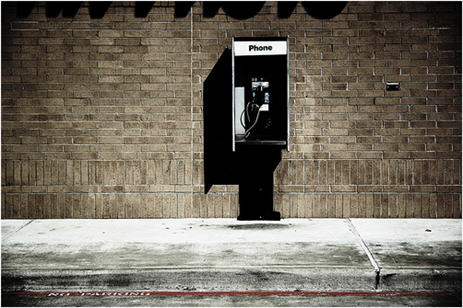
The telephone had yet to be connected in our apartment, prompting my roommate and I to stop at a local convenience store featuring a bright-blue payphone on an outside wall. I had been in Athens just a couple of days, and I knew my parents would worry.

“Dad!”, I exuded. “It is so cool here! They have these little tin houses that look just like boxes, and people live in them!”

“There is a reason you’ve never seen those before.” The tone of his voice invited no further query, and it wasn’t long before I uncovered the stigma attached to those living in what I came to learn were “mobile” homes. Both of my parents had always described apartment dwellers as “itinerants”. As I reasoned the significance of the usually rusted metal hitch sprouting from one side of each of the carefully aligned boxes, I could only imagine how the people residing inside might be described.

Prejudice, fear, and an emphasis on keeping up appearances had proved a remarkably effective shelter.

Shortly after I married, and before I discovered my husband’s addictions, we spent many Sunday afternoons driving around town before heading out into the countryside. Gasoline was cheap then, and we had money for little else. As we headed back into town after a long afternoon spent cruising down country lanes, he asked if I minded if he stopped at a friend’s house on the way home. Several hundred feet after turning off the main road, I saw another form of box-shaped building; row upon row of brick encased boxes with tiny yards featuring an occasional patch of green that passed for grass. Each box looked exactly the same, down to the rusted, ripped screen door that hung tongue-like from its frame.

Ricky steered his prized vintage Cougar into one of the short cement drives.

“I’ll be right back.” The car shook with the force it took to close the extra-long car door. I looked around as I waited, and wondered at the plainness of my surroundings. Except for the occasional hardwood, there was little in the way of greenery, as though nothing would grow in this environment. Crowds of young adults congregated on various corners seemingly oblivious to the squealing children darting between their legs. Many people walked along the streets, calling my attention to driveways inhabited only by rusted tricycles and aged basketball goals that appeared to have sprung from the cracked concrete beneath them.

My husband emerged followed by his friend, a tall, thin African-American man with an amiable face. Ricky grunted with the extra effort required to open the antique car door before introducing him.

“This is Boysie.” He waved his free hand in the direction of the taller man’s smile.

“How ya doin’?” Boysie’s smile grew wider as he spoke, bending at the middle in an effort to see inside our small car.

The two men conversed for several minutes before Ricky slid into the driver’s seat with a “See you, man.”, and the engine roared to life.

As we headed back the way we had come I wondered what my parents would think if they knew I had visited “The Projects”; and, at night! It never occurred to me to wonder what we were doing there. I had no frame of reference. Months would pass before I realized Boysie was my husband’s dealer.

Later, long after I had come to terms with, and rectified, the mistake I’d made in marrying a man I hardly knew, I went to work managing a midwifery practice that served mothers without insurance. Some of the women were Boysie’s neighbors, and many of those that didn’t live in a housing project were on a waiting list.

It was my job to screen patients for eligibility. Lack of insurance was just one requirement. Income and family size were also considered. Most of the women were already receiving government benefits that, at the time, grew with each successive birth. A woman who knew how to work the system might receive child support from more than one man, food stamps, Medicaid for herself and her children, WIC (another government supported nutritional program), and free or nearly free housing. It was no wonder that, very often, the clothes worn by the woman I was interviewing were much more stylish, and expensive, than mine. The benefits paid by our government to women who knew how to work the system gave a whole new meaning to “expendable income”. And who could blame them? In most cases, they had been raised in the same environment, just had their mothers before them. And, it was so easy…

Occasionally, I counseled a woman struggling to support her family on minimum wage. Ironically, the pittance she brought home as a reward for dirtying her hands doing a job most wouldn’t even consider, left her ineligible for assistance of any kind, and usually these women, too, joined the welfare rolls months before thier babies were born. Very soon, I came to think of this situation as “government induced poverty”.

During this time, the Olympic Games were held in Atlanta, and Athens was to host some of the competitions. Much was said about the state of public housing in the area, and the need to clean up before the world came to visit. I was heartened to think that some of our patients’ homes would be receiving much needed repairs, until I realized that the plan was to erect facades crafted of aluminum siding over the fronts of their homes. By the time the torch arrived, the ugly brick boxes had been transformed into quaintly crowded cottages. Flowers had been planted along the borders of newly laid sod. But inside, gaping holes marred many kitchen and bathroom floors in which rusted faucets dripped continuously. Unsightly window air-conditioning units had been removed, as had the rickety screen doors, leaving the inhabitants inside with no relief from ninety-degree heat. It seemed governments, too, were invested in keeping up appearances.

Last week, bulldozers razed the last remaining housing project in Atlanta. Upon hearing this, my first thought was of the residents. Had they been provided for? Did they have homes? Where did they go? It seemed like a heartless act perpetrated on a helpless population.

Upon reading an article in the local paper, I learned that, in 1936, Atlanta was the first city in the nation to erect public housing. I know a lot about my city. Somehow, this inauspicious fact had escaped me. The article went on to suggest that Atlanta is now the first city in the nation to abolish public housing. I continued to read, in hopes that a solution had been offered, and learned that displaced families will receive twenty-seven months of various types of assistance, with a goal towards self-sufficiency.

Further down the page the housing authority’s executive director was quoted as saying that the demolition “marks the end of an era where warehousing families in concentrated poverty will cease.”

Every now and then, we get it right.

© Copyright 2007-2009 Stacye Carroll All Rights Reserved

Granting Wishes


Sometimes, I wish we could go away.

Not far, and down an oft-traveled road, but away.

The water under our deck chairs would absorb our words, whetting our appetites for more.

Sometimes I wish you had more ambition.

Sometimes I wish I had more ambition.

I always wish there was more living in making a living.

Your voice blows against me as we follow the same path in different directions.

But sometimes I watch you talk, and as the words fill the air between us I reacquaint myself with your nose, sitting just a little to the left, and your eyes, the softest shade of jade, and your mouth, which even when you speak turns up slightly on one side as though amused.

I’m in the garden, and out of the corner of my eye I see you hanging my clothes on the clothesline you wish you’d never strung between two trees you wish you had cut down, long ago.

And, I stop what I am doing, and come to you.

© Copyright 2007-2009 Stacye Carroll All Rights Reserved

Sitting on the Patio on a Sunday Morning


Squirrels seem to have an awful lot of fun, no matter what they are doing.

The green of grass after a spring rain remains unduplicated.

Mockingbirds are the maestros of the bird kingdom.

Puppies make all the trouble worth it with one swipe of their tongue.

There are so many things I wish I’d done better.

There are so many things I wish I’d done.

And then, there’s you…

© Copyright 2007-2009 Stacye Carroll All Rights Reserved

Closer


In a house inhabited by an eleven year-old boy, peace and quiet is a true commodity. When I get it I resent any interruption, but particularly the jarring ring of an unanticipated telephone call, just as words begin to flow from my fingertips.

“Hey! Didn’t know if you’d heard…Brenda’s house got broken into today.”

An image of my already anxiety-ridden, widowed neighbor filled my mind.

“They broke out two back windows before her alarm went off, but they didn’t get anything.”

I thanked my neighbor for calling, before dropping my head to my hands in an effort to recapture my thoughts.

It wasn’t until mid-day the next day that I felt it. Some time after lunch; after I’d eaten, and conversed, and excused myself to read with hopes for a nap; I felt the violation. My peaceful, uneventful, quiet cul-de-sac had been violated. An unknown person with nefarious goals had roamed my neighborhood. He’d looked at my house. He’d chosen hers over mine. But, he’d looked at my house, with intent.

I reasoned that the sight of three dogs, of appreciable size, jumping at the kitchen door should be enough to thwart even the bravest of thieves. But what if he was armed?

A picture of my assailant immediately filled the screen of my mind. He was dark, and small, and strangely reminiscent of actor, John Leguimazo, in his short stint on ER last year….

Using the powers of reason still available, I did a quick mental inventory of my valuables, deciding that I was fully insured.

Most days, Shane arrives home several minutes before I do. He calls, as he disembarks the school-bus, and we talk as he walks towards our drive. He’s usually in a hurry, and eager to end the conversation in order to free his hands to unlock the door.

When I answer, he is singing along with my ringback. I am quiet. Listening. Appreciating the gift.

Finished, he finally answers my “Hello”.

“Hey! I had a great day today!”

“Great! I’m happy for you! Tell me what was great about it.” I could do this part of the conversation in my sleep.

“Well…” He always hesitates as he picks through the best parts to give me his favorite.

And while he hesitates, my heart beats just a little faster. What if the John is waiting in the house?

“I had a good day in language arts. Ms. Murray was OK today.”

“Oh, good!” I make a mental note to tone down my enthusiasm. “Any other good news?” My voice, now, is measured, and Mom-like.

“I got an eighty on my math quiz?” He poses a question.

“Wow!” Unbidden enthusiasm creeps back in. “How great is that?” My mind spins, searching for more questions.

“Mom?”, more questions. “I need to go now. I need to unlock the door.”

“Go ahead, honey. I’ll hold on.” Beads of sweat adhere to hair, wisping along my forehead, as I force casualness into my voice.

“Um…ok.” And, I hear “Ok…what’s up with that?”

Holding the receiver ever closer to my ear, I hear the rattling of keys in the lock, the force of paws on the door, and barking.

“Get back!” My son says assertively to his greeters.

“Shane?” I fight for measure in my voice.

“Yeah? I’m about to take the dogs out.” He sounds resigned, placating.

“Do me a favor; before you let them out, just peek outside. Are the gates closed?” I pray he doesn’t hear my ragged breathing.

“Uh…yeah!” He makes no effort to hide his derision as he opens the door. “Yeah, Mom…just like always!”

I laugh, hoping that’s all he hears.

“Cool…”, I answer, nonchalantly.

“How close are you?”, he asks between footsteps.

“Close.”

Wishing I was closer…

© Copyright 2007-2009 Stacye Carroll All Rights Reserved

Pondering Ponds

I can’t begin to guess how many times I’ve passed that pond.

I’ve run by it.

I’ve walked around it.

I’ve gazed upon it, distractedly, while talking on the telephone, or giving my son directions, or parking my car.

Yesterday, I saw the pond.

The sun was amazing; a true spring sun whose soft rays never quite breached the fabric of my tee shirt. Breezes blew from several different directions at once, playing havoc with my hair and Chevy’s nose, dancing, merrily, on the end of his long, narrow snout.

As we rounded the bend, several geese gathered on one side of the pond. Realizing Chevy had never seen geese up close and personal, I seized the opportunity, and I guided him closer to the clearing in which they had gathered. Apparently accustomed to visits, the geese held their ground. The largest of the group sat upon the bank, and without turning, hissed comically. I laughed softly before cooing my assurance, while Chevy ignored her.

And, then I saw the reason for her anxiety. A mother duck, sporting a single striking blue feather amongst her brown and white mottle, swam into view ahead of four tiny, fuzzy ducklings. The goose took a step into the water as they passed. as if to ensure a barrier between us and them. No sooner had the first duck passed when another mother duck, with several chortling ducklings, swam into view. The goose squawked softly as if to say “Hurry along, now!”, and the family glided past. Satisfied, their long-necked protector retook her position on the bank and settled into her feathers.

Feeling we had disturbed the serenity of this part of the pond long enough, I urged Chevy up the hill and around to another arc of the pond. Without a sound, a pile of turtles sunning themselves upon the bank, poured into the water as we approached; the only sign of their retreat a collection of ever-widening circles.

I knew geese stopped here. There were signs of them everywhere, and particularly upon the walking track which they seemed to target with their deposits. In summer, when the sun’s rays swelter, the smell is enough to force me to another part of the track.

But, I hadn’t seen the ducks. And, I didn’t know the turtles. I hadn’t realized that within a very busy county park, these animals had seen fit to create a home in which to procreate. I had never seen the pond as a place of caring that required caring for.

We left the pond, and headed in the direction of Shane, and the batting cages. I thought, again, of the goose; of her protective fervor for those unlike her, and I appreciated the irony.

We have much to learn…

© Copyright 2007-2009 Stacye Carroll All Rights Reserved

Weighing Waiting Women


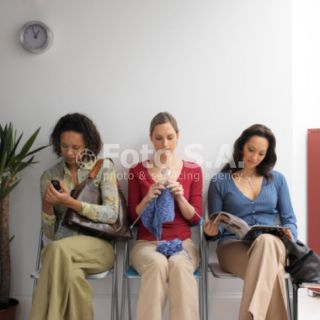
Women learn, from a very early age, to be good waiters.

The first thing I remember waiting for was my birthday. As the oldest of four girls, it was the only day of the year when the spotlight would be for me, and only me. Children came to a party for me. People bought presents for me. Mother baked a cake for me. Birthdays were always worth waiting for.

And then, of course, there was Christmas. True anticipation usually began about a week after Thanksgiving, when large, brown cartons were extracted from the attic and strewn haphazardly about the living room. It was mother’s job to string the lights, which meant more waiting for my sisters and I as we perched on the edge of a couch rarely sat upon, waiting for her signal to breach the boxes. Completion of decoration led only to more waiting. Twinkling, multi-colored lights reflected in our eyes as we “watched” the tree while imagining what hidden treasures lay underneath.

In a house with four girls and one bathroom, there is always a wait.

Soon after my sixteenth birthday, my father presented me with a reasonable facsimile of a car, featuring two seats on four wheels, and very little else. I soon realized it was the seating that concerned him most, and the words “Wait for your sister!” became the bane of my existence.

My sister, Laura, had one speed. A snail once challenged Laura to a foot race. The snail won. Most weekday mornings found me biding my time in an idling car with a blaring radio, for what seemed like hours, as Laura completed her toilette. Weeks of begging, and pleading, and screaming, and warning fell on immutably deaf ears. Finally, I cracked. Bidding her adieu with a foundation-jarring slam of the back door, I jammed the gear shift into reverse. All I remember of my return home is the anger in my mother’s eyes. The rest has been mercifully carved from my memory, but whatever the punishment, it was worth it!

The summer after my senior year in high school was spent waiting by the telephone. I met John, weeks before, while on a trip to Washington, DC with a youth group. When he called, it was to say he would be in Atlanta the following week. My excitement was tempered by the knowledge that I was scheduled to be in Destin on a family vacation. To her credit, my mother allowed me to make the decision. I remember very little of that week spent on the beach, besides a feeling of longing.

College graduation began the wait for my big move. My best friend and I had planned this day for years. Numerous shopping trips for linens, and dishes, and what passed as artwork, made the waiting easier. The experience of living together wasn’t the euphoria we knew it would be, and I gained a valuable life lesson. With the assistance of a good attorney, it only cost $400.00 to get out of the lease.

The only thing more difficult than waiting for the results of a pregnancy test is waiting for his reaction. Pregnancy is the ultimate exercise in waiting. I skipped waiting to discover the gender of my children. A long-ago forbidden foray into my parents’ closet, just before Christmas, had taught me that surprises are to be relished.

Pregnancy came naturally to me, as affirmed by the midwife who announced I had “childbearing hips”. For thirty-six months of my life I was a walking miracle, and I never forgot it.

I loved the quaint expression of being “with child”, and all that came with it. Pregnancy, of course, meant shopping in exclusive shops; exclusive as in those selling maternity clothes, nursing bras, baby furniture, bibs, pacifiers, and the genius that is the One-sie. My children were of the generation first introduced to this remarkable example of adorable efficiency. Thanks to the invention of the One-sie, babies no longer required trussing in order to get to the diaper; just four simple snaps, and you were in!

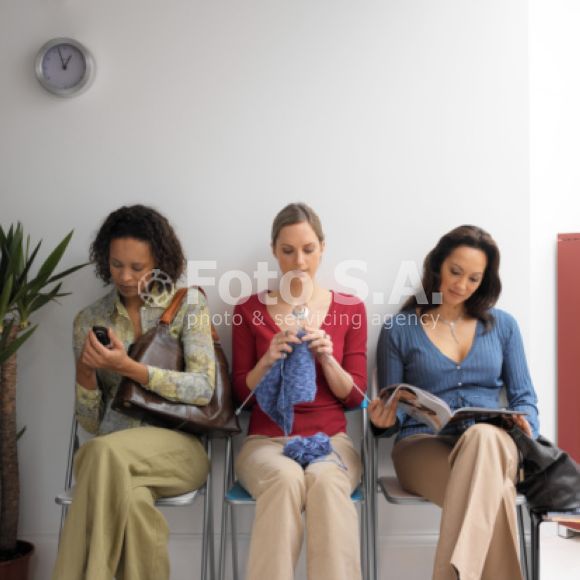
Mothering is synonymous with waiting. Waiting room carpet patterns are memorized, and it isn’t long before a tote bag filled with the necessities of waiting, takes up permanent residence on the back seat of a mother’s car. Mothers wait for hours in check-out lines accompanied by the wailing of an over-tired child; hers or someone else’s. Her first child’s first day of school is torturous for a mother who imagines, all day, trails of tears running down her child’s face when in reality it is her face that is wet. She can’t wait for her baby to come home.

Mothers think of clever ways to pass the time spent in carpool lanes, and later, outside movie theaters and shopping malls. Mothers wait outside dressing rooms until, curious, they grasp the doorknob, prompting the rebuke, “Not yet!”. Mothers wait, sometimes anxiously, for school to start as summer wanes, along with her children’s patience with one another.

As our children grow, waiting mixes with worry. I sat white-knuckled, at the front window, for the full fifteen minutes it took my son to drive around the block for the first time, alone. That was almost ten years ago. Yesterday, when he didn’t arrive within fifteen minutes of our agreed upon time, my face appeared again, at that window.

Even today, I am hard pressed to say which was more shocking, my mother’s announcement of her diagnosis with cancer, or her concurrent use of the word “shit”, as in “Pretty heavy shit, huh?”. On the day of her surgery, the sunny environment of the waiting room, walled floor-to-ceiling by glass, competed with the emotions of the large group of friends and family it housed. Having recently returned to school, I spent most of the day with a textbook. I turned pages filled with words I only appeared to read, until the entry into the room of a small group of green-clad men wearing serious expressions. Their words left no doubt as to the arduous journey ahead, and I would begin my night-time sojourns in the ICU waiting room within weeks.
My father didn’t want my mother left “alone”. He and one or more of my sisters spent the day at the hospital, never missing one of the fifteen minute intervals during which my mother was allowed visitors. Visits were not allowed after nine at night, so my brother-in-law and I took turns sleeping in the waiting room. For many months, waiting became a way of life, as my mother slowly healed.

Commuting lends itself to reflection. Commuting in the rain requires more careful attention, until rainy streets become the norm, and reflections resurface. Such was the case on Wednesday, when, as I rolled to a stop under a murky, red beacon, I realized I have unknowingly adopted a constant state of wait.

Last year was a year of unwanted, if not unexpected, consequences. Reminders of what proved to be an achingly short spate of purest joy, plague me, in the form of physical reminders with psychological presence. The realization that I have been waiting for a different outcome brought an ironic smile to my lips, and a reminder. Inherent in waiting is hope. And, with hope, all things are possible.

© Copyright 2007-2009 Stacye Carroll All Rights Reserved