Older People


I try to avoid labels, all labels. But, I particularly dislike the label we apply to any human blessed with longevity. The term “Senior Citizen” is a misnomer on a number of levels. After all, an older person may not be “Senior” at all. He might be a junior. And what is the significance of “Citizen” here? Aren’t we all citizens? We don’t call babies “Newborn Citizens”. We wouldn’t refer to a forty-year-old as a “Midlife Citizen”. The mere idea sounds awkward and ludicrous.

I have heard the argument that the term “Senior Citizen” was borne out of respect for a person’s advanced age, but I’m not buying it. I believe the term to be market driven, much like the terms “Soccer Mom”, “Gen-Xer”, and “Baby-boomer”. Unfortunately, as the media makes use of these catch-phrases, the terms become part of our collective consciousness, morphing images born as marketing tools into stereotypes with inherently negative connotations.

I don’t like the word “elderly”, either. As soon as it reaches my ear, it becomes another word entirely, registering in my brain as “feeble”. Left with few options, due to my own semantic prejudices, I refer to those “of a certain age” as “older”.

I enjoy older people. I always have. As a young child, one of my best friends was our next-door neighbor, Earl Witcher. I wish I had a dollar for every time my parents told the story of my running, with arms out-stretched, from our driveway to his, shouting “Ale! Ale!”.

As a young mother, I was blessed to live next door to Ruby Kitchens, a hard-scrabble, deeply southern woman of indeterminate age, though her tight, pewter-colored perm suggested at least sixty. Ruby loved babies, which was lucky as I proved to be a prolific bearer. She loved to hold them, sing to them, and make faces at them. And, I enjoyed a rare empty lap as I watched her love them. For eight years we shared a driveway, and our markedly divergent lives, becoming dear friends. When the walls began to close in on my burgeoning family, visits were less frequent, but no less enjoyable. The children she helped me to raise are adults now, and Ruby has been gone for many years, yet I still think of her several times a week.

~~~

Joy is a spritely eighty-five, though if you ask her, she isn’t a day over eighty-three. Lucie turned eighty this year, passing the day in the hospital bed she has occupied since she was seventy-eight.

Joy came to work in our office three years ago, and within weeks had become one of my favorite things about weekdays. Last February, Lucie was the first hospice patient assigned to my care. I fell in love on sight.

Joy runs circles around most of the much younger employees in our office, coaxing productivity out of office equipment most of us have never learned to use, and doing it with a smile. Lucie is paralyzed, from the neck down, as the result of a stroke. She lays, a helpless, horribly contracted heap, in the center of her twin-sized world. She is completely dependent on others to meet her needs, and she doesn’t mind telling you what they are. I rarely visit without a small container of vanilla ice-cream.

Joy hums. You don’t so much look for Joy, as listen for her. The one time Joy isn’t humming is when she is talking, and she loves to talk. Her conversations usually surround some form of culture; she might recommend a book she’s just finished reading, or review a night at the symphony or an afternoon spent at the museum. An avid “Dancing with the Stars” fan, she loves to rehash the latest episode while stirring hot chocolate mix into a cup of steaming hot water.

Lucie’s eyes are usually closed when I enter her room. I’m careful to bend close before I say her name quietly, while softly touching one tiny, bony shoulder. Despite her efforts to open them, her right eye never fully cooperates, prompting my perch on the left side of her bed.

“Miss Lucie? It’s Stacye…” I encourage her to wakefulness.

“Hey!” She exudes enthusiasm in a voice barely above a whisper.

“It’s Saturday, Miss Lucie, February twenty-first, almost spring-time! How are you doing today?” I slide one hip up onto the bed, feeling the egg-crate mattress beneath its thin cotton covering.

“Oh…I’m alright…” She answers every time.

I stand, and move to draw the drapes.

“You want these open, don’t you Miss Lucie? Look at that gorgeous sunshine!”

I return to the side of her bed.

“Are you eating?” At last check she weighed less than seventy pounds.

“These people don’t cook right.” She answers with a lop-sided sneer and averted eyes.

“It’s not what you’re used to, is it?”

“It sure ain’t!” Images from an earlier visit, remnants of camouflage-colored puree decorating thick, institutional stoneware, fill my head.

White noise, from the television she insists must play at all times, accompanies our words. Sometimes I carry the conversation. Raised by a father whose green thumb was more of a necessity than a hobby, Lucie loves to hear about my garden.

And, when she’s up to it, Lucie has stories to tell. Hours, spent at her bedside, have taught me much about life in pre-integration Atlanta, as she takes me along on the bus ride across town to “care for a white family”. Most interesting, though, are her ruminations on Lucie; Lucie the daughter, Lucie the independent woman, Lucie the single mother. The injured cadence of her voice urges me closer, as she shares her disappointment in the father of her only child who “…left, and never came back”.

Two framed photographs provide the only break in the institutional green of our surroundings. Lucie’s grandson smiles through an eight-by-ten rectangle of glass. And, just underneath, hangs a six-by-four photo of his infant son, also known as “the baby”.

“Did your grandson bring the baby to see you this week?”, I ask as I dab at the unbidden tear falling from an eye that won’t quite open.

“Nah…”, she answers. “He’s busy…”

“Well, I bet he’ll be here next week!” I rise to leave, readjusting the blankets displaced by my hip.

Bending, I kiss her shiny, cocoa-colored forehead.

“I’m going now, Miss Lucie. I’ll see you next week…”

“Alright…”

“I love you.”

“I love you, too.”

© Copyright 2007-2009 Stacye Carroll All Rights Reserved

“Worry Beads”


As a civil engineer working with a large real estate firm, my father was part of the boom that built Atlanta during the 1960’s. It was in this way we came to know the Kwechs, a family of Chicagoan transplants. They talked funny, slathered both sides of their sandwiches with butter instead of mayonnaise, and ate pickled fruit. They were also Catholic, which was my mother’s way of explaining Mrs. Kwech’s habit of pinning a handkerchief into her hair before entering a church.

As we sat down to a Thanksgiving dinner featuring butter molded into the shape of a lamb alongside pickled peaches, all five Kwechs made a mysterious hand-motion after “the blessing”. Fascinated, I studied the motion and practiced it; thinking it “neat”, until my mother reprimanded me. This was the first time I heard the word “sacrilegious”.

Of course, my mother’s horror only served to accentuate the exotic nature of this mysterious faith. Obviously, the Catholic Church was much more holy than the garden-variety, Southern Methodist church I’d been brought up in.

I am a Jack-of-all-churches, and master of none. I have studied most of the major religions, and many of the lesser known. Faith, as a practice, fascinates me. So it is, that almost forty years later, I understand that much of the mystery of the Catholic faith isn’t so much a matter of secrecy as it is ritual. Still, compared to Methodism, one of the least imaginative religions ever practiced, Catholicism piqued my interest.

It’s aura lies in its accoutrement; priests in fine robes with satin sashes and impressive head-gear, an assortment of ranked deities, confessionals, and, of course, the rosary.

The first rosary I ever saw was made of rose quartz. I remember thinking it beautiful. Respecting my mother’s admonition, I never considered I could own one until learning that Catholic’s don’t own the patent on the rosary. It seems that this, like so many Protestant traditions, is a practice borrowed from a much older religion.

Buddhists, too, worry rosaries, or malas, during prayer. Traditionally consisting of one hundred and eight beads, a mala is used to keep count while reciting a mantra in meditation. Elizabeth Gilbert elaborated on this tradition, beautifully, in her book “Eat, Pray, Love”. In the book, she points out the symbolism of the number three, inherent in the Buddhist mala. She refers to the number of beads, one hundred and eight, as the perfect number because, while being divisible by three, its individual numbers add up to nine, which, when perfectly divided, also amounts to three, a number of importance in many religions; as in Father, Son, and Holy Ghost.

After reading, and being inspired by, Ms. Gilbert’s book, I ordered and received a Tibetan mala. One hundred and eight, perfectly symmetrical, wooden beads line up along a piece of ordinary twine that, purportedly, has been blessed by one or more Tibetan monks. The beads came protected by a tiny satin, hand-embroidered purse, and they reside within the confines of my over-sized, designer hand-bag.

Today, after receiving several prayer requests from an assortment of friends, residing in a variety of locales across the globe, I retrieved the beads. They rode in my pant’s pocket for most of the day, and now, are secreted against my chest.

Oils, from my hands, lend a new-found gleam to their wooden faces, as my touch reminds me of their purpose, and I pray…

© Copyright 2007-2009 Stacye Carroll All Rights Reserved

Oh, My Darlin’…


“You wait!” A familiar sneer leant my mother’s words an equally familiar tone of acridity. “You wait! You’ll wish you had this time back! Time moves faster the older you get. Why, at my age, a year goes by in a blink of an eye.”

As a kid, who had probably just bemoaned a yawning three week wait until Christmas, her admonition had no more effect than her frequent wishes for my future.

“I hope you have children, and I hope they cause you just as much trouble as you’ve caused me.”

As it turned out, she was right, on both counts.

I have heard the month of January described as meaningless after the hustle and bustle of a holiday season that now seems to span several months. There is, of course, an introspective aspect to January, coming as it does, after weeks of economic, gastronomic, and even alcoholic depravity.

New Year’s Day dawns on millions of hung-over, antacid-swilling Americans, who greet the day holding a television remote control. Football-filled hours pass in a semi-upright position, interrupted only by the odors of foods said to be infused with magic powers on this day, and this day only. More often than not, it is while we are pushing collard greens around the perimeter of our plate, that someone floats the topic of New Year’s resolutions. As we anticipate finally being able to access a beer without encountering a well-maintained eyebrow raised by the “time police”, we attempt to discern a recognizable image in the smattering of cornbread crumbs stuck in gravy remnants before answering.

And, no matter the answer, we finally manage to pull from the refuse that is our dinner plate, one thing is sure; by January thirty-first we will have forgotten it. This is the stuff of January.

Recently, though, I’ve discovered other reasons to mark January.

January is the month of the Clementine. In case you are not familiar with this delectable nugget of sugary citrus, a Clementine is cousin to the tangerine. A friend tried, for years, to sell me on their merits, but to my discerning eye they appeared nothing more than a miniature tangerine at twice the price. I couldn’t imagine anything about them being worth double the money…until my son tasted them.

Usually imported from Spain and neighboring regions, these tiny, orange morsels are sold almost exclusively in crates. This feature originally, prohibited me from buying them. This year, after tasting one provided by my friend, I decided to chance unloading a crate of citrus on a family usually partial to meatier fruits such as apples, pears, and melons. Within days, my son was urging me to return to the store for another crate, and when I tasted one, I understood why.

That was three crates ago, and on Saturday, I carefully placed one of the last three available into my grocery cart. Clementine season is winding down. We’re treating this crate as though it will be our last, because it just might be.

This weekend, I discovered another reason to mark the passing of January. My Christmas cacti, inaccurately named as they begin blooming just after Thanksgiving, are waning. I have, over the years, collected a virtual grove of cacti by taking advantage of post-holiday plant sales. At present I nurture eight, in varying shades. This year, for the first time, all of them bloomed.

My grandmother raised Christmas cacti, and I loved one of them, especially. It was at least two feet in diameter, and bloomed in a lovely, deep, shade of pink. Visits to her house were warm, due in part to her attention to the thermostat, but also because of our shared interests. She knew I loved plants, and she loved to share. Every time I visited, she pinched off shoots of any plant I admired, urging me to root them. And, I did.

Today, my largest Christmas cactus, started as an offshoot of the one I so admired, measures over two feet in diameter. She is old. There are unattractive striations upon her leaves, and yet she blooms, gloriously, year after year. When others tease, putting out buds that never come to full fruition before the foliage shrivels; she blooms, and blooms, and blooms. I fertilize her, in warmer months. I water her, judiciously at first, until the buds begin to squeeze from her succulent fronds, whereupon I strengthen her by plying her with liquid. And she responds to my ministrations, year after year, after year.

Withered blooms fell into my watering can yesterday. The show is nearly over. As I looked around the sunroom, I enjoyed, possibly for the last time, each and every bloom; bright pink, salmon red, and white, with just a trace of pink lining each petal.

And I marked January, wondering where the time had gone.

© Copyright 2007-2009 Stacye Carroll All Rights Reserved

Biscuits


I never mastered the art of biscuits.

Though she didn’t do it very often, my mother made excellent biscuits. She called them Angel biscuits. Feeding a family of my own, I googled the recipe, and tried it. My children, whose exposure to sports was limited to the southern mainstays of football and baseball, exhibited an unexpected knowledge of hockey in describing an appropriate use for these biscuits.

My father enjoyed bread with dinner but, more often than not, his yen was satisfied by two slices of “Colonial” white bread riding one side of his generously filled plate. The rest of us ate breadless, and the blessing does not go unrecognized.

Holidays were marked by “dinner rolls”, usually purchased from Rich’s bake-shop. I remember them as small, delectable, little fluffs of bread. I probably could have eaten my weight in them, but the napkin lining the bread basket was carefully secured after the first offering, and my father’s hand was the only one allowed a second chance.

To my mind, the pièce de résistance of the roll kingdom measured a mere finger-width, and was only offered as an accessory to a bucket of Kentucky Fried Chicken. One of these, cradling a dollop of gravy, and I forgot all about the chicken. Long ago, these rolls went the way of Rich’s bake-shop, replaced, of course, by biscuits.

Occasionally, and usually at breakfast, my mother rapped open a can of biscuits. My father seemed satisfied no matter what form of fiber sat upon his plate. I, however, found canned biscuits an unsatisfactory fabrication of the real thing. No amount of grape jelly transformed this pig’s ear into a satin purse.

My former husband was raised in the tiny town of Jefferson, Georgia, by a mother who knew her way around a southern kitchen. And while he never complained about the dinners I fashioned from the tins and boxes of my youth, he moved canned green beans from one side of his mouth to the other, as he told stories of bigger, greener beans, slow-cooked on the back of a stove for hours, and biscuits, used to sop up the “pot liquor”.

He was there when I attempted to recreate my mother’s angelic recipe, graciously refusing to lend his voice to the discussion of ice-hockey, choosing instead to described biscuits the way he’d come to know them; large squares, cut from a single slab of dough. It became my mission to uncover this long-held culinary secret.

Viola Carroll was a formidable woman. Striated skin, hanging from space once occupied by her tricep, spoke of former girth. She was tall, a good six inches taller than I, and vocal. If she thought it, she said it; and, this knowledge, alone, was enough to put me on my best behavior. I dressed, before we left, in my most becoming casual outfit, in an effort to quell her tongue. Viola expected a woman to be “dressed”.

Our arrival was always met graciously, as Viola went for her purse. Viola always needed something from the grocery store. She gamely folded her generous frame into the bucket-seat of my aged Toyota wearing a look of anticipation heretofore only seen on a canine head hung from a car window.

As we bounced between traffic lights, Viola steadied herself upon a black, vinyl handbag boasting a faux-gold snap.

“I like yowah little cah, but this heah road sho is bumpy!”

Even now, the memory of those words brings a smile to my face.

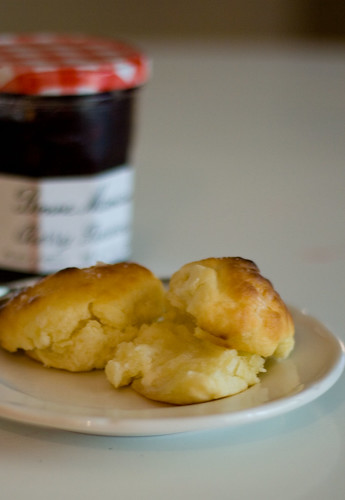
Our foray of the local discount grocery store complete, Viola demonstrated, for me, the artistry of southern biscuits. They were, indeed, carved from a single slab of dough which she manipulated between country-sized hands, for several minutes, before slamming the mass onto an unsuspecting jelly-roll pan. A large, well-worn, butcher’s knife quickly separated the colorless blob into generous squares before her hands bounced the sides into shape. The result was toasted to a golden hue on top, leaving the middle ethereally transparent. As the fibrous mass melted upon my tongue, I knew nothing I could conjure would recreate that kind of bliss.

Fortunately, for me, there was “Bisquick”; a couple of cups of powder, poured from a gaily-colored box, mixed with water, and voilà, biscuits! Following, Viola’s example, I slammed tablespoon-sized blobs onto an unsuspecting jelly-roll pan.

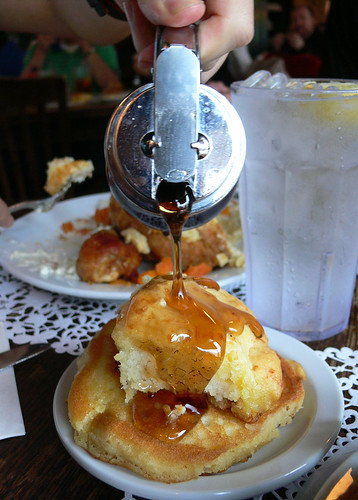
Today, on the rare occasion I venture to place biscuits on my southern dinner table, I must first remove them from a frozen, plastic bag. I understand the result is every bit as satisfying as my mother’s Angels, and Viola’s squares, especially when dunked in yellow syrup.

© Copyright 2007-2009 Stacye Carroll All Rights Reserved