Blame Game

Image

As the oldest of four girls, I heard the question, “Who did this?”, a lot.  “Where did that come from?” ran a close second, but never knocked “Who did this?” out of first place.

The question, of course, always led to pointing fingers and defensive whines.  The words “…but she…” were thrown around quite a bit.  I’m not saying those fingers were usually pointed at me…but my mother would.

Fast forward lots of years.  It’s the late 80’s.  MTV still played music videos and John Bradshaw was the darling of public television.  Mr. Bradshaw wrote a book called “Healing The Shame That Binds You”, among others.  He was featured prominently during pledge week.  At the time, I was hoarding quarters in hopes of collecting enough to buy a box of Hamburger Helper, but I often dreamed of pledging and, when I did, I determined to do the magnanimous thing.  I’d tell them to keep their silly old umbrella.

Bradshaw fascinated me for a number of reasons.  He was good looking for one.  And he had a great voice; a voice a father would have if you had that kind of father.  You know the kind; the kind whose lap was yours for the taking, the kind that listened, the kind that comforted.

No, I didn’t have that kind either.

The thing I remember most when thinking of John Bradshaw, besides his delicious shock of salt and pepper hair, is the mobile.  That’s what sucked me in, really; it was a simple thing.  It might even have been made from a clothes hanger.  Family members, represented by shapes cut from shiny paper, dangled from it.  Bradshaw used the mobile to demonstrate that instability in one family member threw everyone else off balance.  With a flick of his finger, he’d send one paper doll spinning.  The rest followed suit in a crazy chaotic dance that demonstrated it didn’t matter who jumped first; in the end they were all hopelessly tangled up in their own strings.

Everyone loves a good whodunit…Who was the last one here?  Who took the last paper towel?  Who left the seat up?  Who spilled the tea?  Who moved the remote control?  Who left the window down?  And the classic…who let the dogs out?

Our society’s obsession with blame is the main reason I no longer talk politics.  It’s impossible to make a comment, no matter how innocuous, without someone borrowing from my sisters and I; “But, he…”, “But, she….”, “But, they…”   And we all know what happens next.

Mom gets the switch.

She never seemed to notice, but I did.  Nothing good ever came from getting a switch.  Despite her admonitions to the contrary, there was always lots of crying and, afterwards, Mom was red-faced and sweaty.  We didn’t stop doing what she didn’t want us to do, we just did it better, more quietly, and with a heightened sense of accomplishment.

As the rare liberal living and working in a red sea of Bible-based Republicans, I’ve kept my head down since the partial government shut-down.  (Even typing those words feels ridiculous…but I digress.)  You can hear better with your head down, and what I hear is a lot of blaming.  The paper dolls are dancing, and everyone is so busy pointing out who jumped first that no one noticed Mom going for the switch.

Maybe Ken Fisher watched John Bradshaw too.  Fisher is the chairman of the Fisher House Foundation.  On Wednesday, Fisher House committed to providing death benefits and transportation to family members of soldiers killed in the line of duty.  Ken Fisher didn’t ask “who”.  He kept his fingers to himself and, instead of muddying the waters with feckless accusations; he provided a solution to a problem caused by lesser men with bigger titles and lots to lose.

You can learn more about Fisher House Foundation here:  http://www.fisherhouse.org/

Photo credit:   http://www.diabetesmine.com/wp-content/uploads/2012/09/pointing-finger.jpg
Collateral Damage: Let Them Eat Cake

Image

There were enough breaks in the clouds to remind us there could be sun.  Rain didn’t fall as much as spurt from the sky, intermittently, and with little power behind it.  But it was enough to soak the picnic benches, prompting several of us to muscle the tables further under the shelter and away from the fireplace where Josh built a fire.  Lush green grass and blooming trees aside, you’d never have guessed it was April in Atlanta.

In my usual state of rebellion, I’d worn flip-flops under my blue jeans and hoodie.  Within minutes of arriving, I was grateful I listened when a voice of reason couched in loving kindness urged me to throw a pair of shoes in the car “just in case”.  It was tricky business switching out my footwear without getting my socks wet, but I managed.  As I perched inside the door on the backseat of my car, a steady stream of soggy guests passed on the other side.

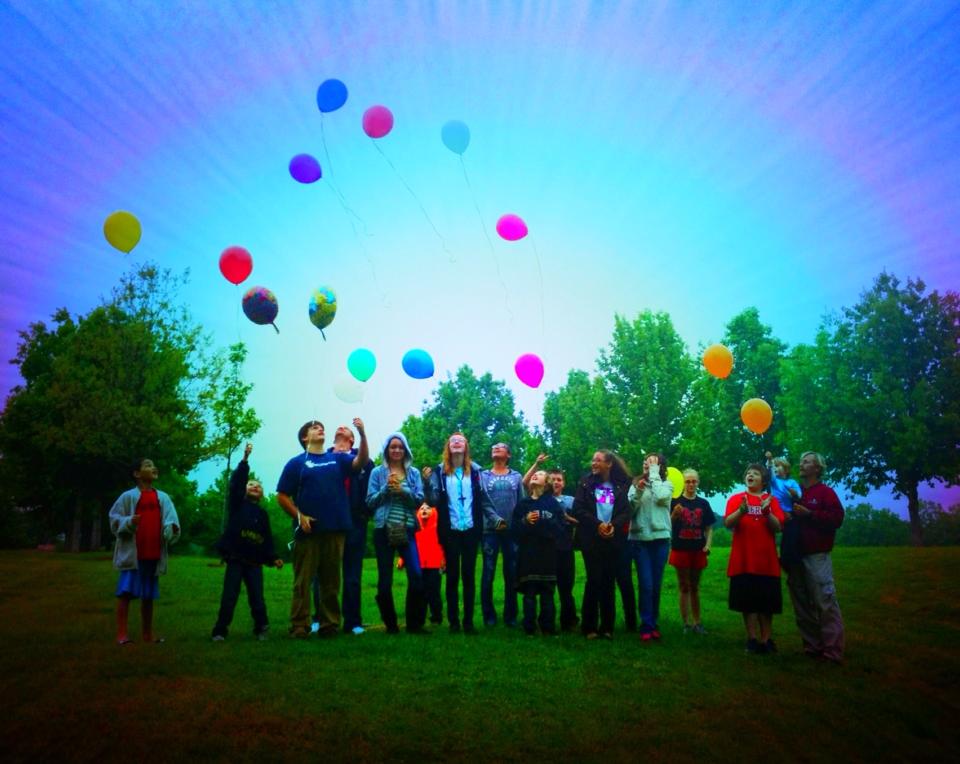
By the time I emerged, the party was well under way.  A large, multi-colored balloon bouquet swayed languidly over a chocolate birthday cake. The smell of grilling meat billowed from a flume on one side of the grill, an array of chips and desserts filled one of the tables, and a football sailed, occasionally, over the heads of laughing children.  Hoods were on heads, hands were in pockets, and breath floated like conversation bubbles over the heads of guests, happy to see each other.  Things would have been very nearly perfect if only Trey could have been there.  For the second time, we celebrated his birth after his death.

In the days leading up to the party, I marveled at how well I was handling things.  There had been no crying jags or heavy sighs.  I wasn’t sleeping particularly well but, as a woman of a certain age, there were any number of possible explanations for that.

And then, someone mentioned ketchup.  Which made me think of mustard.  Which made me think of mayonnaise, and cheese, and relish, and trash bags, and streamers, and noise-makers, and all the other incidentals that would normally come without thinking when planning a birthday cook-out.  Except that nothing was normal.  Normal hadn’t happened yet.  Perhaps it never will.  And, if it ever does, it won’t be on that day.  That day, Trey’s birthday, will never be normal again.

I didn’t realize until I got there how much I hadn’t wanted to come, or how little I’d done to prepare.   Luckily a store down the street stocked most of what I’d forgotten and, by the time the burgers were done, we had everything we needed.

People attended the party for different reasons.  Some, like me, came out of a sense of obligation.  Some came to celebrate the life of a friend.  At least one came for the company, and a few came for the food.  I realized though, as I looked over the crowd, that despite our personal motivations, we were all there for the same reason.

We were collateral damage.

Facing the Mirror


I think about that old mirror often.

It was, at least, five feet long, and two feet high at it’s tallest point, which featured painstakingly carved intricate flowers and filigree. Two wooden slats divided the glass into three separate mirrors, and, long ago, someone had burnished the wooden frame golden.

I came upon it while helping my elderly next-door neighbor, Ruby, remove years of flea-market finds, incredible buys, and assorted debris from what was to have been a spare room. Ruby was everything her name implies. She was also a packrat.

As I pulled the awkwardly shaped mirror out from behind a crib mattress Ruby was sure she might need one day, I immediately noticed the craftsmanship. The detail, the inaccuracies, and the aged brown paper, stretched across the back of the frame, proclaimed “hand-crafted”.

Turning it to once again admire the carvings, I caught Ruby’s reflection in one of the panels. She stood behind me, and a little away; and, on her face, a look of adoration, usually reserved for my children.. Glancing at her, I asked the question without words, and she began to tell the story.

The mirror had been in her family as long as she could remember, which was a very long time. It had been the centerpiece of her grandmother’s dining room, and then, later, her mother’s “front room”. She wasn’t clear as to whose hands had done the carving, but she knew he had presented it to the family as a treasured heirloom, and they had treated it as such, for decades. Regret replaced delight as she explained it’s present home.

“I used to have a place to hang such things, but I don’t anymore.”

Coming closer, she raised one gnarled hand towards the apex of the frame and rested it upon the most elaborate of it’s decoration. After several seconds, she used the same hand to retrieve the ever-present tissue from the pocket of her shapeless sweater, and dabbed tobacco juice from one corner of her lined, colorless mouth.

“I want you to have it.”, she proclaimed, and turned back to the box she had been pillaging before my find.

I stared at her bent back for several seconds, before challenging her decision by suggesting she consider making a gift to one of her two daughters.

“Do you see either one of them here today?”, she barked as she rose creakily, turning slanted eyes in my direction. “Huh? Do ya?”

Several seconds passed in uncomfortable silence before she closed, quietly, with “Alright, then.”

I hung the mirror, that evening, over the sofa in my living room, and it was, once again, the centerpiece it was meant to be. It hung there for several years, until the size of my family exhausted the space inside the little house next door to Ruby, forcing us to leave our friend. But, her mirror made the trip. In total, I moved the mirror to three different homes. Ruby would see the mirror hung in all but the last, but, somehow, I’m sure she knew it was there.

During my most recent move, light packing, invoked by emergent situations, left the mirror hanging for the next occupants to admire. And, I hope they did. I hope the decades of love and care stroked into it’s wood demanded the respect it, and she deserved. And, Ruby, who was everything that name implies, understands.

© Copyright 2007-2008 Stacye Carroll