>
© Copyright 2007-2010 Stacye Carroll All Rights Reserved
>
© Copyright 2007-2010 Stacye Carroll All Rights Reserved

Shane’s long-time baby-sitter, Christin, invited us to her graduation ceremony. The invitation, and the opportunity it presented, seemed timely.
Shane will start eighth grade in the fall or, as he puts it, he’ll be the “Big Dog”. So many facets of Shane’s life serve to accentuate the fact that the upcoming school year will be a period of transition, a stepping stone if you will, from one phase of life into another. As high school graduation should be the pinnacle of this next phase, attending the event seemed an opportunity to plant a seed, to secure a goal, to expose him to all the pomp and circumstance afforded scholastic achievement.
He balked only slightly when I insisted he wear dress shoes and the imagined pain of buttoning his button-down was assuaged by the mirror over my shoulder, as a slight jerk of his head almost produced the coveted swish of Justin Bieber hair.
“Hey, Mom! I look kinda good!” He’s a slightly pudgy thirteen-year-old. “Kinda” IS good.
Christin had called earlier in the day. Her words were punctuated by a distinctive “click” as she released long golden curls from the clutches of a steaming curling iron. Her usually swift cadence was enhanced by excitement as she shared ticket information and encouraged early arrival.
“You’llbesittinginbleachersIt’sgoingtobehotbutthey’resellingChick-fil-asothereisthat.”
We parked at the church next to the high school and walked a down-hill block to the stadium. Shane’s baseball coach met us as we circled the football field.
“Luke’s up there somewhere.”, he shaded his eyes against the burning twilight, searching for his son. “There!”, he pointed.
Shane asked the question with a lift of his eyebrows. I answered with a blink and a nod, and he began a clumsy ascent towards his friend
We were early. There were plenty of seats to choose from. I headed for an empty metal bench in the center, and as I climbed towards my perch, overheard someone make reference to the fifty-yard-line. It felt out of place
Easing onto a very warm aluminum bench, I was disappointed to realize that the stage had been set up facing the opposite side of the field. They were, apparently, playing to the “home” crowd. A handful of people scurried to and fro around the stage as though assigned a very important task, but no one actually seemed to do anything. A golf cart sped past the bleachers several times. The sun had dipped below the treetops, but left her heat behind.
A group of people wearing black caps and gowns approached the stage area. It took me a minute or so to realize that they were teachers and not really old looking students. Mentally, I chastised myself for the mistake. It’s not as though I’d never attended a graduation before. I’d seen those same caps and gowns at my own graduation.
Of course, my graduation took place downtown, in the air-conditioned comfort of the Municipal Auditorium. And the event was actually a culmination of events that had taken place over the preceding two weeks. Parents feted their children with parties that felt a lot like bridal showers feel today. An assortment of gifts flowed in from my parents friends, many of whom I’d never met. Most sent money, but one relative sent a boxed set of Anais-Anais perfume. I was so impressed! It seemed so…continental! I wonder if it’s still available…
Crimson colored caps and gowns were delivered to the school two weeks before graduation and taken to the music room for fittings. We stood in line with our friends, waiting our turn while sharing our enthusiasm and an occasional joke at the expense of students whose heads measured extra-large. Afterwards, a group of us went out to lunch and, later, to the mall. It didn’t matter that we would be wearing calf-length gowns. The occasion called for a new dress. And shoes, of course.
Something about the prospect of walking down an aisle prompts profuse primping. Not until I married would I again spend so much time in front of a mirror. I emerged from the bedroom I shared with my sister to find my family waiting in the den. My father wore a suit and tie, my sisters, their Easter shoes, and my mother, heels under a skirt that probably hadn’t seen the light of day more than once or twice since she’d owned it. We all piled into Mom’s Vista Cruiser station wagon and headed downtown.
The auditorium was dark except for tiny lights imbedded in the aisle seats. My family went inside while I followed a beckoning, black-shrouded teacher whose job it was to herd graduates backstage.
The noise we made as we assembled ourselves upon the risers behind the curtain seemed deafening. I was sure our parents could hear. The relative darkness only served to accentuate the heavy blanket of expectancy that fueled our collective state of giddiness. Several robed teachers stood in front of the risers alternately moving students who had yet to master the alphabet and threatening rowdy boys by addressing them as “Mister”.
And the music began…daaaa, dadada, daaaa-da, daaaa, dadada, daaaaaah. A nervous silence fell over my class. Even the rowdy boys stood a little taller.
“Excuse me…”
I woke from my reverie to the face of a young father wearing cargo shorts with a baby dangling off one arm. He looked pointedly at the bleacher beneath my feet.
“Oh! I’m sorry!” I turned towards the aisle, allowing him passage. A young African-American man climbed the steps towards me. He wore blue jeans under a t-shirt which exposed carefully cultivated biceps. Very large basketball shoes bloomed beneath his pants. Loosened laces allowed for a protruding tongue. The toddler perched in the crook of his right arm made repeated attempts to dislodge his doo rag.
Behind him, a middle-aged woman in tank top and shorts, pushed a mop of unruly blonde curls from her face as she searched for a bench long enough to contain her similarly clad contingent.
I shifted on the bench that was becoming harder and more uncomfortable by the minute to see that two rows of black robes were filing in towards the stage.
The man sitting next to me leaned in, “Why are some of the kids wearing black robes, while the others are wearing white?” I felt so vindicated…
The presence of a tiny sea-foam-suited woman waving her arms, frantically, in front of a small group of students wielding instruments was the only indication that music was playing. The air around me was filled with the cacophony of mixing voices, frequent laughter, and the occasional baby crying. Suddenly the fifty-yard-line comment seemed less inappropriate.
This time I leaned in. “Are these people just going to talk through the entire ceremony? It’s bad enough we can’t see. We aren’t going to be able to hear either?”
My position granted me a line of sight though which I could see Shane. His eyes were focused as he sat immobile save for his thumbs, which danced rapidly over the controls of Luke’s Gameboy.
Four rows down, a slightly overweight, middle-aged man sat in a suit and tie. His hands folded and unfolded a program as he surveyed the crowd.

I was asked, recently, to list fifteen books that had “stuck with me”. The only directive given was that I not to take too long to answer, but instead, record the first fifteen that occurred to me. It wasn’t an easy task. I never read a book more than once, because I can’t stand the feeling I get, somewhere around the twentieth page, that I know exactly what is going to happen when the protagonist rounds the corner. I like to think this is the reason I struggle to recall book titles, and worse yet, author’s names. What I do remember is plot, storyline, and bits and pieces of the tale that spoke to me as I read.
Compiling a list proved a challenge, but I resolved to follow the rules, and when a title or author escaped me, I searched online with what little information I had retained. The end result proved eclectic, and even as I listed the books, I silently bemoaned the omission of many of my favorite authors. But on that particular day, their books did not stand out, and there was a rule…
Upon reading it over, there were a couple of books I resisted the urge to remove. There is a romance novel on the list. I read romance novels, as most girls did, while in high school. There is a book that enjoyed Oprah Winfrey’s favor before the author was found to have fabricated a story his publisher chose to market as a memoir. As always before posting anything publicly, I considered the reactions of those I care about, and those whose opinions I care about. The two groups do not necessarily overlap. Finally, I reminded myself of the author’s urging not to belabor the list, and posted it as it stood.
On reading it over, I am struck by the number of unique experiences and feelings I associate with each book. Some of them were particularly striking…
One truly would have had to live under a rock to avoid the media surrounding Elizabeth Gilbert’s book “Eat, Pray, Love”. At some point I came to feel that, as a woman, this book was required reading. I was hooked before the end of the first chapter. Elizabeth was a woman like me. Actually, she had a lot more money than I have. Other than that though, she paints herself as an “ordinary Jane”, who overcame the kind of desperation most women have felt at one time or another. I am completely cognizant of the fact that had she not enjoyed her apparent wealth, her experiences might not have been possible. Still, I am grateful to her for sharing them, for absorbing the cool of bathroom tile into her cheek right alongside me, and for helping me to believe that complete metamorphosis is possible.
To the best of my recollection, “The Scarlet Letter”, by Nathaniel Hawthorne, was required reading in the seventh grade. It is the first time I can remember being truly affected by a book. I felt such pity for Hester Prynne, who had given herself over to her emotions, and in so doing, sacrificed her life and that of her “bastard” child. The lessons of this book were particularly poignant to a thirteen-year-old girl who seemingly went out of her way to be different, while praying no one would notice.
A friend loaned me her CD version of Anne Lamott’s “Plan B: Further Thoughts on Faith”. Being an avid reader, I had never thought to “listen” to a book, but I do have a long commute and my friend was adamant that I would enjoy it. I listened to it four times through before I returned it, and immediately bought a copy for myself and a friend who I knew would experience it just as I had. Four days after I dropped her copy into the mailbox, my telephone rang, very early, on a Saturday morning. My friend was driving in a rain that obscured her eyesight even more than the tears I heard in her voice. “Thank you!”, she sobbed. “I had to pull over. I’m on my way to pick up my son, and the dog just died, and thank you. Thank you so much for sharing this with me.” I knew the dog she spoke of. I too had shed tears, more than once, upon hearing Anne describe the scene in her bedroom, as she brought her son in to see their beloved pet one last time.
“The Reader”, by Bernhard Schlink was literally forced upon me by my friend Joy. In her mid-eighties, Joy still consumes a book a week. As she described the plot, I heard only the word “holocaust”, and immediately decided this book was not for me. Joy insisted, pressing the small volume into my undesiring hands. I was immediately struck by the darkness of the setting, the hopelessness of his characters, and the need.
“Loving Frank”, by Nancy Horan, details the turbulently forbidden love affair between Mamah Borthwick Cheney and Frank Lloyd Wright. Cheney seemingly had it all; beauty, intelligence, a career, a loving husband, and adoring children. At one point, she worked as a translator for a Swedish feminist, in hopes that her benefactor’s doctrine would take hold in the United States. A chance meeting with Frank Lloyd Wright’s wife served as the catalyst that would change all their lives, leading to a violent end for Mamah and one of her children. There are so many aspects to Mamah’s character to which I can relate. And I know, from personal experience, that there is a Frank Lloyd Wright for all of us…
I know the disease of alcoholism, first-hand. My grandmother and mother “drank too much”. My father, though now sober, is an alcoholic, as is his brother. My grandfather was an alcoholic. I married two of them, and now my second son struggles with his legacy. Though living under this cloud all my life, I never truly understood addiction until I read the book “A Million Little Pieces”, by James Frey. Strangely enough, the passages that meant most to me had nothing to do with drugs or alcohol. Instead, the main character, who resides, yet again, in a rehabilitation facility, finds himself unable to control his appetite for food. His description gave me real clarity as to the meaning of addiction, the way it works, and how it feels. I shared the book with my son, and replaced it when he lost it in one of his many moves. I hope, one day, it will speak to him as it did to me.
I own a couple of different volumes of the “Tao te Ching”, but Stephen Mitchell’s is the first that came to mind. Basically described, the book outlines the basic principles of Daoism, an ancient religion of Chinese origin that first piqued my interest during a college history class. I am most impressed by the simplicity of the doctrine and abundance of love inherent in it. I garner inspiration from its verses and keep a copy near me at all times.
“We put thirty spokes together and call it a wheel;
But it is on the space where there is nothing that the usefulness of the wheel depends.
We turn clay to make a vessel;
But it is on the space where there is nothing that the usefulness of the vessel depends.
We pierce doors and windows to make a house;
And it is on these spaces where there is nothing that the usefulness of the house depends.
Therefore just as we take advantage of what is, we should recognize the usefulness of what is not.” (chap. 11, tr. Waley)
“The Metamorphosis”, by Franz Kafka, made a tremendous impact on me as a college student who didn’t even realize dung beetles existed. I remember researching them online, after reading about Gregor’s transformation. Familiarizing myself with the ins and outs of their existence did nothing to quell my horror. Gregor’s existence as a pariah, whose family actually felt relief at his demise, spoke to me.
The last book on my list was “Shanna”, by Kathleen Woodiwiss, a sultry, romance novel featuring the standard red-headed, high-strung heroine, and her dark, tortured suitor. I thought, long and hard, before letting the title stand. I know I was in high school when I read this book because I was, at the time, working afternoons at Dunkin’ Donuts with a woman twice my age. I know this because it was actually this woman that left the impression.
She was slight, almost pixie-like, with a voice to match. Her name escapes me, but I will never forget her face. For reasons she never revealed, she shaved her eyebrows, and trimmed her eyelashes because they were “too long”. I had worked with her for several months, when on her afternoon off, she brought her daughter in for a mid-afternoon snack.
Shanna was about three, with long, wispy, platinum hair and trimmed eyelashes, just like her mother. I remember standing mute, as my co-worker explained the need for trimming. All I could think of was the proximity of a sharp object to the eyes of a child not yet in full command of her body. It was my first encounter with a “single mother”, a “bastard child”, and many other social circumstances my parents would rather I not have encountered. This beautiful child, through no fault of her own, carried an ugly label, suffered needless danger to her eyesight at the hands of a mother obsessed the lash length, and, worst of all, was named for the heroine in a romance novel.
Shanna would be over thirty years old now; her mother, near sixty. I wonder occasionally if Shanna still clips her lashes, and if, as I’ve always heard, they actually grow in longer for the trimming. Did she follow in her mother’s footsteps? Does she paint on her eyebrows every morning? Does she pour coffee while sharing a laugh with the same five men each morning? Did she ever query the origins of her name?

I’ve had occasion, lately, to consider my “firsts”; my first kiss, my first sleep-over, my first job…
Days after completing the survey, I find myself still considering. While applying make-up, my first pair of boots walk through my mind. They were black patent leather, and the sound of those heels on institutional tile transformed me from a twelve year-old, angst-ridden seventh-grader into a confident, edgy, prepubescent force. While driving to work, I hear the sound of horses’ hooves on pavement as I relive my first carriage ride. It was mid-afternoon. We were in Chattanooga, on streets packed with tourists. But, the fact of him beside me dimmed the sun, stilled the crowd, and isolated our love to a single point in the middle of a busy thoroughfare wherein we were the only two souls that mattered.
I wish I’d appreciated my “firsts” more. I wish someone had reminded me, before I turned back to make sure no one was watching through a front window, that I would be allowed just one first time to surrender to Jimmy’s embrace. I wish someone had been there to whisper in my ear, “This will be your only first date.” It would have been helpful if, before placing her into my arms for the first time, the nurse had looked at me knowingly as she said, “This is your first, and only, daughter.”
I’ve reached the age when thinking of “firsts” leads, naturally, to consideration of a growing number of “lasts”. I’ve birthed all the children I will ever bear. I will never again feel the sweet pull of infant lips upon my breast, or feel the rush of emotion in realizing the miracle inherent in our relationship.
Since the age of twenty-one, sex has been a repetitive act. And, while each encounter offers a new and wonderful experience, nothing is like the first time; the virgin time. As synthetic fibers scratched against my bare back, I wish I’d had the wisdom to consider; is this the right place, the right time, the right man? Are you ready to be a mother?
What if, before you first stepped onto your college campus, a guide stopped you, taking you by the arms? “Stop!”, he might have said. “Stop, and look around. This is the only first time you will walk upon the ground that will change your life. Your next step will forge your destiny. The decisions you make now will determine your life course, because tomorrow will be your second time.”
I enjoyed driving my first car, but might I have enjoyed it more if I knew that I’d never see another one like it? Would I have relished the feeling of pumping the clutch, and finding the gears, if I knew I’d never feel that again?
I will never again reap the harvest from my first garden. I can never again get my first perfect score in English, or Math, or Spanish, or bowling. I have already baked my first birthday cake.
I know there are more “firsts” ahead of me; my first stress test, my first colonoscopy, my first AARP card. And, I hope for more; my first published book, my first trip overseas, my first healthy dill plant. I can’t grow dill. I’ve tried, and tried.
One day, I know I’m going to find just the right spot…
I can’t begin to guess how many times I’ve passed that pond.
I’ve run by it.
I’ve walked around it.
I’ve gazed upon it, distractedly, while talking on the telephone, or giving my son directions, or parking my car.
Yesterday, I saw the pond.
The sun was amazing; a true spring sun whose soft rays never quite breached the fabric of my tee shirt. Breezes blew from several different directions at once, playing havoc with my hair and Chevy’s nose, dancing, merrily, on the end of his long, narrow snout.
As we rounded the bend, several geese gathered on one side of the pond. Realizing Chevy had never seen geese up close and personal, I seized the opportunity, and I guided him closer to the clearing in which they had gathered. Apparently accustomed to visits, the geese held their ground. The largest of the group sat upon the bank, and without turning, hissed comically. I laughed softly before cooing my assurance, while Chevy ignored her.
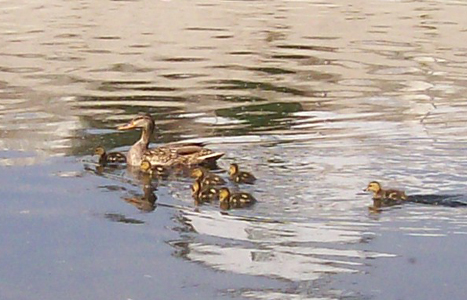
And, then I saw the reason for her anxiety. A mother duck, sporting a single striking blue feather amongst her brown and white mottle, swam into view ahead of four tiny, fuzzy ducklings. The goose took a step into the water as they passed. as if to ensure a barrier between us and them. No sooner had the first duck passed when another mother duck, with several chortling ducklings, swam into view. The goose squawked softly as if to say “Hurry along, now!”, and the family glided past. Satisfied, their long-necked protector retook her position on the bank and settled into her feathers.
Feeling we had disturbed the serenity of this part of the pond long enough, I urged Chevy up the hill and around to another arc of the pond. Without a sound, a pile of turtles sunning themselves upon the bank, poured into the water as we approached; the only sign of their retreat a collection of ever-widening circles.
I knew geese stopped here. There were signs of them everywhere, and particularly upon the walking track which they seemed to target with their deposits. In summer, when the sun’s rays swelter, the smell is enough to force me to another part of the track.
But, I hadn’t seen the ducks. And, I didn’t know the turtles. I hadn’t realized that within a very busy county park, these animals had seen fit to create a home in which to procreate. I had never seen the pond as a place of caring that required caring for.
We left the pond, and headed in the direction of Shane, and the batting cages. I thought, again, of the goose; of her protective fervor for those unlike her, and I appreciated the irony.
We have much to learn…

Our trip was unexpected, unplanned, and unbudgeted, which helps to explain my presence in the drive-thru line at McDonald’s at 11:47 a.m. We rolled to a stop in front of a daunting menu of gastronomic atrocities too crowded to read. I allowed my eleven-year-old to order for both of us.
“Please drive around to the first window.”
A heavy-set girl with long brown hair manned the register, behind a small glass door that seemingly opened and closed of its own accord. I hit the mute button on the stereo as she logged another order. She turned in our direction, and the door opened as she extended her hand, palm up. I laid several bills inside with a smile that went unnoticed as she stashed them before collecting my change while focusing, intently, on the LED display of the register. Her left hand extended again, dropping my change while her right hand hit a button on her head set, and I rolled to the second window.
A hundred miles or so later, my cup was empty, but my bladder wasn’t. I searched large, green, roadside signs for another iconic fast-food restaurant that would offer relief for both. As I rolled into the Krystal’s parking lot, my son sat forward on his seat.
“Are we going to eat again?” Shane’s voice sounded exactly like you would expect it to sound, given his usual diet of whole grains, fish, and fruit.
“No, honey. Just the bathroom and a drink!”
As I entered the bathroom, I was accosted by an odor that said “Turn back!” in a deep, unnerving voice. Shaking it off, I pushed open the painted metal door, expecting the worst. I considered myself lucky in not uncovering the source of the odor and attended to the matter at hand, post-haste. I rinsed my hands hurriedly, and opened the door with my elbow. Shane was waiting outside.
The counter was clear of customers, allowing us to stand, unimpeded, in front of the register. A large woman, whose hairstyle must have cost at least a day’s pay, approached from the back of the restaurant throwing one hand in the direction of another woman as her eyes glazed mine.
“You got customers.”, she said as she walked by, carrying a sheaf of paper cups.
The woman she addressed stood at the other end of the counter, bent at the middle, her face just inches above a laminated paper.
“You really got her worried ‘bout that schedule!”, the female voice came, complete with laughter, from the grill area.
A painfully thin, uniformed young man approached from the dining area.
“Whatchew doin’?” He mimicked her posture so that their visored heads met.
Shane and I stood with necks arched; studying a menu we had no intention of ordering from, until a man wearing a white shirt that said “I Am The Manager” approached, carrying a bundle of bags.
“Can I take your order?” I was relieved to hear self-consciousness in his voice.
Sunlight did nothing to enhance the pallor present on my friend’s skin as we sat around her picnic table. We sipped, and laughed, and talked, and laughed. The telephone rang, and she answered it. I made my decision while she assured our friend I had made the trip safely.
As she pressed “End”, I eased myself off the weathered, wooden bench.
“We’re going to get a room.”
She argued despite my tone of finality.
“It’s just two miles away….” I ended the conversation.
I hit the button, locking my son safely inside the car before walking towards the lobby. A blonde woman who hadn’t yet accepted the reality of her morbidity manned the desk.
Her expression never changed as she managed, “You want a room?”
I leaned both arms on the desk as she typed, wondering if she knew that the boxed-blonde curtain hanging down either side of her haggard face failed to hide the collection of chins the years had provided her.
Tiny cowbells rang, and we both turned. Shane entered, mute. He approached a display of brochures while I felt validation.
“How old is the child?”
“Eleven.”
Several minutes and colorful invectives later, I tapped Shane’s shoulder and left with credit card-shaped “keys”.
“Mom?” I pulled my sweatshirt closed as we walked against a cool breeze.
“Yes.” Shane hurried to catch up to my stride.
“Aren’t there a lot of people looking for jobs?”
“Yes.”, I answered, not sure where he was going.
“Then why does everybody act like they hate their job? Don’t they know they’re lucky to have one?”
From the mouths of babes…
© Copyright 2007-2009 Stacye Carroll All Rights Reserved

I love to sing. I used to be pretty good at it; good enough to be asked to sing in a band. My stint there afforded me the opportunity to work as a background singer in a local studio, but family obligations sang louder, and I retired my tambourine.
I now perform in very limited engagements. With my IPOD as accompaniment, I sing as I clean, and croon when I garden. And, playing Beth Hart wide open, in my car, has been known to illicit a throaty growl or two. On one such occasion, when my son and I were running Saturday errands, he asked, “Where did you learn to sing like that?”.
I’m an avid gardener, and surround myself with growing things year-round. My vegetable garden satisfies my preference for fresh herbs while providing a variety of fruits and vegetables for friends and family. And, I never met a flower I didn’t like.
For years, my gardens were populated randomly, by an assortment of annuals. Lately though, I’ve tended towards more permanent plantings and the creation of gardening environments, my favorite being an “English Garden”. The space is a constant work in progress, as the drought we’ve suffered for the last two years has taken a toll, but I love knowing that a feeling of peace and connectivity is as close as a stroll through my own backyard.
Last week, a friend and I shared a glass of merlot on my patio, surrounded by a cacophony of pansies in hues ranging from deepest purple to palest yellow. She remarked on their beauty, the way they winked in the breeze, and their fragile strength. “Where did you get your green thumb?”, she asked.
My family has always been appreciative of my writing. They comprise a large block of my readership. It was, in fact, at the persistent prodding of my youngest sister that I began to blog.
I’ve written since I was a young girl, though not always on paper. An ongoing saga, detailing the lives of a homeless, orphaned girl and the brother she cared for, provided pleasant distraction for what seemed like hours and hours as I mowed the front lawn. Recently, I’ve come to regret that I never gave the story permanence. I have attempted, on occasion, to recreate the drama, but only tiny bits and pieces remain in my much older brain.
A high school English teacher took an interest in my work, asking my permission to submit two of my poems to a literary journal. She provided me with a copy of the finished product which was left behind, along with my music boxes, Barbie dolls, and a complete set of Nancy Drew mysteries, when I struck out on my own. I wish now I’d packed an extra box…
Last week, my aunt sent me a nice note in praise of my writing, and for at least the second time mused as to its legacy. “Where do you think that talent comes from?”, she queried. “We don’t have any other writers in the family!” I hadn’t thought to ask that question. I’d never pondered the parentage of my propensities.
Yesterday, as I aimed my pencil at a sketch I’ve been working on, my mother’s unbidden image swam into view. She sat head down, at the kitchen table. Using one of our number two pencils, she transformed a simple sheet of blue-lined notebook paper into a work of art. And there are more memories; of sitting in the back seat of our station wagon and wondering why she wasn’t singing on the radio, and of plants, rows and rows of growing green things. Later in life, she took painting classes, and, even now, her needlework hangs on my walls.
I brought the pencil closer to the paper, angling the point to achieve shading that suggests shadow, knowing it is her hand that guides me. And, I appreciate the legacy…

Women learn, from a very early age, to be good waiters.
The first thing I remember waiting for was my birthday. As the oldest of four girls, it was the only day of the year when the spotlight would be for me, and only me. Children came to a party for me. People bought presents for me. Mother baked a cake for me. Birthdays were always worth waiting for.
And then, of course, there was Christmas. True anticipation usually began about a week after Thanksgiving, when large, brown cartons were extracted from the attic and strewn haphazardly about the living room. It was mother’s job to string the lights, which meant more waiting for my sisters and I as we perched on the edge of a couch rarely sat upon, waiting for her signal to breach the boxes. Completion of decoration led only to more waiting. Twinkling, multi-colored lights reflected in our eyes as we “watched” the tree while imagining what hidden treasures lay underneath.
In a house with four girls and one bathroom, there is always a wait.
Soon after my sixteenth birthday, my father presented me with a reasonable facsimile of a car, featuring two seats on four wheels, and very little else. I soon realized it was the seating that concerned him most, and the words “Wait for your sister!” became the bane of my existence.
My sister, Laura, had one speed. A snail once challenged Laura to a foot race. The snail won. Most weekday mornings found me biding my time in an idling car with a blaring radio, for what seemed like hours, as Laura completed her toilette. Weeks of begging, and pleading, and screaming, and warning fell on immutably deaf ears. Finally, I cracked. Bidding her adieu with a foundation-jarring slam of the back door, I jammed the gear shift into reverse. All I remember of my return home is the anger in my mother’s eyes. The rest has been mercifully carved from my memory, but whatever the punishment, it was worth it!
The summer after my senior year in high school was spent waiting by the telephone. I met John, weeks before, while on a trip to Washington, DC with a youth group. When he called, it was to say he would be in Atlanta the following week. My excitement was tempered by the knowledge that I was scheduled to be in Destin on a family vacation. To her credit, my mother allowed me to make the decision. I remember very little of that week spent on the beach, besides a feeling of longing.
College graduation began the wait for my big move. My best friend and I had planned this day for years. Numerous shopping trips for linens, and dishes, and what passed as artwork, made the waiting easier. The experience of living together wasn’t the euphoria we knew it would be, and I gained a valuable life lesson. With the assistance of a good attorney, it only cost $400.00 to get out of the lease.
The only thing more difficult than waiting for the results of a pregnancy test is waiting for his reaction. Pregnancy is the ultimate exercise in waiting. I skipped waiting to discover the gender of my children. A long-ago forbidden foray into my parents’ closet, just before Christmas, had taught me that surprises are to be relished.
Pregnancy came naturally to me, as affirmed by the midwife who announced I had “childbearing hips”. For thirty-six months of my life I was a walking miracle, and I never forgot it.
I loved the quaint expression of being “with child”, and all that came with it. Pregnancy, of course, meant shopping in exclusive shops; exclusive as in those selling maternity clothes, nursing bras, baby furniture, bibs, pacifiers, and the genius that is the One-sie. My children were of the generation first introduced to this remarkable example of adorable efficiency. Thanks to the invention of the One-sie, babies no longer required trussing in order to get to the diaper; just four simple snaps, and you were in!
Mothering is synonymous with waiting. Waiting room carpet patterns are memorized, and it isn’t long before a tote bag filled with the necessities of waiting, takes up permanent residence on the back seat of a mother’s car. Mothers wait for hours in check-out lines accompanied by the wailing of an over-tired child; hers or someone else’s. Her first child’s first day of school is torturous for a mother who imagines, all day, trails of tears running down her child’s face when in reality it is her face that is wet. She can’t wait for her baby to come home.
Mothers think of clever ways to pass the time spent in carpool lanes, and later, outside movie theaters and shopping malls. Mothers wait outside dressing rooms until, curious, they grasp the doorknob, prompting the rebuke, “Not yet!”. Mothers wait, sometimes anxiously, for school to start as summer wanes, along with her children’s patience with one another.
As our children grow, waiting mixes with worry. I sat white-knuckled, at the front window, for the full fifteen minutes it took my son to drive around the block for the first time, alone. That was almost ten years ago. Yesterday, when he didn’t arrive within fifteen minutes of our agreed upon time, my face appeared again, at that window.
Even today, I am hard pressed to say which was more shocking, my mother’s announcement of her diagnosis with cancer, or her concurrent use of the word “shit”, as in “Pretty heavy shit, huh?”. On the day of her surgery, the sunny environment of the waiting room, walled floor-to-ceiling by glass, competed with the emotions of the large group of friends and family it housed. Having recently returned to school, I spent most of the day with a textbook. I turned pages filled with words I only appeared to read, until the entry into the room of a small group of green-clad men wearing serious expressions. Their words left no doubt as to the arduous journey ahead, and I would begin my night-time sojourns in the ICU waiting room within weeks.
My father didn’t want my mother left “alone”. He and one or more of my sisters spent the day at the hospital, never missing one of the fifteen minute intervals during which my mother was allowed visitors. Visits were not allowed after nine at night, so my brother-in-law and I took turns sleeping in the waiting room. For many months, waiting became a way of life, as my mother slowly healed.
Commuting lends itself to reflection. Commuting in the rain requires more careful attention, until rainy streets become the norm, and reflections resurface. Such was the case on Wednesday, when, as I rolled to a stop under a murky, red beacon, I realized I have unknowingly adopted a constant state of wait.
Last year was a year of unwanted, if not unexpected, consequences. Reminders of what proved to be an achingly short spate of purest joy, plague me, in the form of physical reminders with psychological presence. The realization that I have been waiting for a different outcome brought an ironic smile to my lips, and a reminder. Inherent in waiting is hope. And, with hope, all things are possible.

I try to avoid labels, all labels. But, I particularly dislike the label we apply to any human blessed with longevity. The term “Senior Citizen” is a misnomer on a number of levels. After all, an older person may not be “Senior” at all. He might be a junior. And what is the significance of “Citizen” here? Aren’t we all citizens? We don’t call babies “Newborn Citizens”. We wouldn’t refer to a forty-year-old as a “Midlife Citizen”. The mere idea sounds awkward and ludicrous.
I have heard the argument that the term “Senior Citizen” was borne out of respect for a person’s advanced age, but I’m not buying it. I believe the term to be market driven, much like the terms “Soccer Mom”, “Gen-Xer”, and “Baby-boomer”. Unfortunately, as the media makes use of these catch-phrases, the terms become part of our collective consciousness, morphing images born as marketing tools into stereotypes with inherently negative connotations.
I don’t like the word “elderly”, either. As soon as it reaches my ear, it becomes another word entirely, registering in my brain as “feeble”. Left with few options, due to my own semantic prejudices, I refer to those “of a certain age” as “older”.
I enjoy older people. I always have. As a young child, one of my best friends was our next-door neighbor, Earl Witcher. I wish I had a dollar for every time my parents told the story of my running, with arms out-stretched, from our driveway to his, shouting “Ale! Ale!”.
As a young mother, I was blessed to live next door to Ruby Kitchens, a hard-scrabble, deeply southern woman of indeterminate age, though her tight, pewter-colored perm suggested at least sixty. Ruby loved babies, which was lucky as I proved to be a prolific bearer. She loved to hold them, sing to them, and make faces at them. And, I enjoyed a rare empty lap as I watched her love them. For eight years we shared a driveway, and our markedly divergent lives, becoming dear friends. When the walls began to close in on my burgeoning family, visits were less frequent, but no less enjoyable. The children she helped me to raise are adults now, and Ruby has been gone for many years, yet I still think of her several times a week.
~~~
Joy is a spritely eighty-five, though if you ask her, she isn’t a day over eighty-three. Lucie turned eighty this year, passing the day in the hospital bed she has occupied since she was seventy-eight.
Joy came to work in our office three years ago, and within weeks had become one of my favorite things about weekdays. Last February, Lucie was the first hospice patient assigned to my care. I fell in love on sight.
Joy runs circles around most of the much younger employees in our office, coaxing productivity out of office equipment most of us have never learned to use, and doing it with a smile. Lucie is paralyzed, from the neck down, as the result of a stroke. She lays, a helpless, horribly contracted heap, in the center of her twin-sized world. She is completely dependent on others to meet her needs, and she doesn’t mind telling you what they are. I rarely visit without a small container of vanilla ice-cream.
Joy hums. You don’t so much look for Joy, as listen for her. The one time Joy isn’t humming is when she is talking, and she loves to talk. Her conversations usually surround some form of culture; she might recommend a book she’s just finished reading, or review a night at the symphony or an afternoon spent at the museum. An avid “Dancing with the Stars” fan, she loves to rehash the latest episode while stirring hot chocolate mix into a cup of steaming hot water.
Lucie’s eyes are usually closed when I enter her room. I’m careful to bend close before I say her name quietly, while softly touching one tiny, bony shoulder. Despite her efforts to open them, her right eye never fully cooperates, prompting my perch on the left side of her bed.
“Miss Lucie? It’s Stacye…” I encourage her to wakefulness.
“Hey!” She exudes enthusiasm in a voice barely above a whisper.
“It’s Saturday, Miss Lucie, February twenty-first, almost spring-time! How are you doing today?” I slide one hip up onto the bed, feeling the egg-crate mattress beneath its thin cotton covering.
“Oh…I’m alright…” She answers every time.
I stand, and move to draw the drapes.
“You want these open, don’t you Miss Lucie? Look at that gorgeous sunshine!”
I return to the side of her bed.
“Are you eating?” At last check she weighed less than seventy pounds.
“These people don’t cook right.” She answers with a lop-sided sneer and averted eyes.
“It’s not what you’re used to, is it?”
“It sure ain’t!” Images from an earlier visit, remnants of camouflage-colored puree decorating thick, institutional stoneware, fill my head.
White noise, from the television she insists must play at all times, accompanies our words. Sometimes I carry the conversation. Raised by a father whose green thumb was more of a necessity than a hobby, Lucie loves to hear about my garden.
And, when she’s up to it, Lucie has stories to tell. Hours, spent at her bedside, have taught me much about life in pre-integration Atlanta, as she takes me along on the bus ride across town to “care for a white family”. Most interesting, though, are her ruminations on Lucie; Lucie the daughter, Lucie the independent woman, Lucie the single mother. The injured cadence of her voice urges me closer, as she shares her disappointment in the father of her only child who “…left, and never came back”.
Two framed photographs provide the only break in the institutional green of our surroundings. Lucie’s grandson smiles through an eight-by-ten rectangle of glass. And, just underneath, hangs a six-by-four photo of his infant son, also known as “the baby”.
“Did your grandson bring the baby to see you this week?”, I ask as I dab at the unbidden tear falling from an eye that won’t quite open.
“Nah…”, she answers. “He’s busy…”
“Well, I bet he’ll be here next week!” I rise to leave, readjusting the blankets displaced by my hip.
Bending, I kiss her shiny, cocoa-colored forehead.
“I’m going now, Miss Lucie. I’ll see you next week…”
“Alright…”
“I love you.”
“I love you, too.”

As a civil engineer working with a large real estate firm, my father was part of the boom that built Atlanta during the 1960’s. It was in this way we came to know the Kwechs, a family of Chicagoan transplants. They talked funny, slathered both sides of their sandwiches with butter instead of mayonnaise, and ate pickled fruit. They were also Catholic, which was my mother’s way of explaining Mrs. Kwech’s habit of pinning a handkerchief into her hair before entering a church.
As we sat down to a Thanksgiving dinner featuring butter molded into the shape of a lamb alongside pickled peaches, all five Kwechs made a mysterious hand-motion after “the blessing”. Fascinated, I studied the motion and practiced it; thinking it “neat”, until my mother reprimanded me. This was the first time I heard the word “sacrilegious”.
Of course, my mother’s horror only served to accentuate the exotic nature of this mysterious faith. Obviously, the Catholic Church was much more holy than the garden-variety, Southern Methodist church I’d been brought up in.
I am a Jack-of-all-churches, and master of none. I have studied most of the major religions, and many of the lesser known. Faith, as a practice, fascinates me. So it is, that almost forty years later, I understand that much of the mystery of the Catholic faith isn’t so much a matter of secrecy as it is ritual. Still, compared to Methodism, one of the least imaginative religions ever practiced, Catholicism piqued my interest.
It’s aura lies in its accoutrement; priests in fine robes with satin sashes and impressive head-gear, an assortment of ranked deities, confessionals, and, of course, the rosary.
The first rosary I ever saw was made of rose quartz. I remember thinking it beautiful. Respecting my mother’s admonition, I never considered I could own one until learning that Catholic’s don’t own the patent on the rosary. It seems that this, like so many Protestant traditions, is a practice borrowed from a much older religion.
Buddhists, too, worry rosaries, or malas, during prayer. Traditionally consisting of one hundred and eight beads, a mala is used to keep count while reciting a mantra in meditation. Elizabeth Gilbert elaborated on this tradition, beautifully, in her book “Eat, Pray, Love”. In the book, she points out the symbolism of the number three, inherent in the Buddhist mala. She refers to the number of beads, one hundred and eight, as the perfect number because, while being divisible by three, its individual numbers add up to nine, which, when perfectly divided, also amounts to three, a number of importance in many religions; as in Father, Son, and Holy Ghost.
After reading, and being inspired by, Ms. Gilbert’s book, I ordered and received a Tibetan mala. One hundred and eight, perfectly symmetrical, wooden beads line up along a piece of ordinary twine that, purportedly, has been blessed by one or more Tibetan monks. The beads came protected by a tiny satin, hand-embroidered purse, and they reside within the confines of my over-sized, designer hand-bag.
Today, after receiving several prayer requests from an assortment of friends, residing in a variety of locales across the globe, I retrieved the beads. They rode in my pant’s pocket for most of the day, and now, are secreted against my chest.
Oils, from my hands, lend a new-found gleam to their wooden faces, as my touch reminds me of their purpose, and I pray…
Inspiration for Domestication
Noun doyenne: The senior or eldest female member of a group, especially one who is most or highly respected. A woman who is highly experienced and knowledgeable in a particular field, subject, or line of work; expert Synonym: grande dame
"Sex, Drugs and Rock and Roll from a 75 year old woman --- with some stories, life experiences and wisdom thrown in."
Life • Art • Technology