To Bake, Or Not to Bake

So, apparently, The Rapture is scheduled to take place tomorrow, May 21st.  Or October 21st.  Or, possibly some time in between.  I guess that’s why, though he announced a date, Reverend Camping left us guessing as to time. 
And, that’s unfortunate.
You see, it’s clean-up day at the high school tomorrow.  All football players and their parents are expected to attend.  I suppose we could blow it off.  I mean, it’s not as though they’ll be taking attendance, right?  But there’s this feeling that if you don’t show up, the coach will notice.  You’d be passing up an opportunity for face time, a chance to make an impression so indelible as to create a presence he won’t be able to ignore while fine-tuning the starting line-up.  Yes, there is the perception that a day like tomorrow could make or break a kid’s high school football career, rapture notwithstanding.
I spoke with my grandson yesterday.  He finished the conversation the same way he always does.
“When am I coming to your house, Nonni?
Had Reverend Camping seen fit to settle on a time, I might have planned a short visit.  I could have arranged a sort of Bon Voyage party, just in case.  I mean, granted, Elijah probably hasn’t been born again, but that could be because it hasn’t been an awfully long time since he was born the first time.  Surely the selection committee wouldn’t hold that against him, right?
My son’s birthday is Monday, and he really, really wants to be fourteen.  After all, he’s had a whole year to plan.  In anticipation of the event, I purchased a pretty fancy guitar.  It’d be a shame if he never got to play it, but I could probably get my money back.  There are sure to be plenty of guitar players left behind…
And, of course, a pending rapture calls into question the need for cake.  To bake, or not to bake?  The cake my son has requested is, when complete, three layers of decadent gooey goodness.  The ingredients aren’t cheap and preparation takes some time; time possibly better spent on “making arrangements”, if you catch my drift…
On the way to dinner tonight, my son gave a lecture on rapture.  His knowledge was impressive considering his formal religious education is spotty, at best. 
“The whole thing is bogus, Mom.  I mean, anybody who reads the Bible knows that even predicting the rapture is a sin!  Nobody’s supposed to know when that’s going to happen!”

This is the point at which I realized my son has been receiving Bible lessons from someone other than me.  We’ve discussed God, rehashed stories, investigated traditions, and read many of the Psalms.  I love the Psalms.  David is among my favorite poets.  But we only discussed Rapture once.  I remember we were watching VH1….

© Copyright 2007-2011 Stacye Carroll All Rights Reserved

Godsmack

When I was young, my mother deposited my sisters and me on the sidewalk in front of the Methodist Church every Sunday morning. It only made sense to go inside. Especially in winter, since Sunday was the one day a week we were forced to wear dresses. Vicious winter winds whipped the hems of our skirts, pushing us towards the double doors leading to the sanctuary.

Before long, it became achingly apparent that those double doors actually led to a sort of sanctified catwalk and, as soon as the Richway opened on the opposite corner, my entry into the sanctuary was little more than a detour.

As a teenager, summer Sundays found me in a tiny, white, clapboard church, chiefly populated by elderly Baptists. Attendance was requisite to spending the weekend at Mrs. Wise’s magical, heart-of-pine farmhouse. I liken the experience to being a visitor in a strange country. Few of their traditions were familiar to me. But, we were allowed to wear pants, and the friendly parishioners seemed uninterested in where you had bought them or how much they cost. Everyone appeared truly happy to be there, and even happier to see a new, young face.

I toyed with the idea of converting, until I learned that Southern Baptists disallow a plethora of enjoyable activities; among them, dancing. I am not a frequent dancer, and when I do dance, I don’t do it particularly well. But, I value the freedom to do so when the spirit moves me…

 As a mother, I returned to the Methodist church. And, not just to make a deposit. I actually attended along with my children. By this time, a few avant-garde women were wearing pants, but I stuck to my skirts. As a stay-at-home Mom, I embraced any opportunity to wear make-up and pantyhose.

We attended for several years. My children joined youth groups and were baptized on video. Several years ago, while cleaning the attic, I found the VHS tape in a box filled with books. I gave it to my daughter who watches it with her brothers, on occasion. It reminds them of a pleasant time.

While my children were being sprinkled, however, florid men in Sunday suits were arguing the benefit/cost ratio of a lottery in Georgia. The argument spilled over into the church. Political fire-storm soon superseded religious education, and it became apparent that, while this congregation didn’t stand in judgment of one’s fashion sense, it made no bones about dictating a political stance.

I didn’t attend church in search of a political science lesson. I attended church in search of religious education, for me and for my children. As the level of negativity within the congregation grew, I once again beat a retreat, with one yearly exception.

Every Christmas Eve, we happily interrupted the preparations and festivities for an opportunity to touch God. Inside the sanctuary, the lighting was ambient, the music inspired, and the presence of God more tangible than at any other time in my experience. I always left the church better than when I went in, grateful for the peace and hope He had placed within my heart.

Of course, I see God everyday. What more perfect evidence is there of God’s presence than a bird? These marvelous creatures, who carry everything necessary for life in a tiny feathered bundle that defies gravity, effortlessly. What better proof could there be of the Divine?

And I feel Him working in my life, especially when I have dropped the ball. He usually lets me have my head long enough to realize I’ve lost sight of the finish line, before pulling back on the reins hard enough to unseat me. And, often, it’s not until I’ve regained my composure enough to brush myself off that I realize I’ve just enjoyed a Holy Smack-Down. This realization usually prompts the first smile I’ve allowed myself for days.

You have to smile. It’s just like being a kid; a kid who does something she knows she shouldn’t. And Dad comes in with that look on his face that tells you he knows. He knows and he isn’t happy about it. The only relief for the anxiety inspired by that face is retribution. And, you secretly smile. After Dad leaves the room, you smile. And, for a while you behave, content in the knowledge that when you don’t, when humanity rears its ugly head again, He’ll be there to jerk the reins.

Smooth Criminal


The day after Michael Jackson’s death, a local radio deejay made this observation, “In less than a month, we’ve lost David Carradine, Farrah Fawcett, and Michael Jackson. The seventies are officially dead.” The statement struck a chord with me.

Despite his age, I was surprised to hear of Carradine’s passing. His appropriately thin, zen-inspiring image almost seemed capable of transcending death. It saddened me to learn that Farrah had finally succumbed to the cancer she’d been fighting, valiantly, for years. She seemed to have felt joy in life.

Michael Jackson’s death made me angry.

I watch very little television, and have made no exception for the smothering blanket of press coverage foisted upon us by all the major news organizations. It boggles the mind that CNN devoted nearly two entire days to Michael Jackson, as North Korea perfects its nuclear aim and Iranians continue to die while their president attempts to bully Americans with sophomoric word games. But, I haven’t been able to avoid the travesty entirely.

My son just discovered Michael Jackson’s music last year, when “Fall Out Boy” did a cover of “Beat It”. He asked to hear the original version, deemed it superior, and ended up downloading the entire “Thriller” album onto his IPOD. Thursday evening, while returning home from dinner out with a friend and his mother, Shane heard the news of Jackson’s death on the car radio. He was bursting with the announcement when he came home, and seeing he was affected, we watched some of the news coverage together.

The piece was a retrospective, and when Joe Jackson’s seemingly perpetually angry visage filled the screen, I identified the emotion I’d been carrying for most of the day.

Over the last twenty years, much as been written about Joe Jackson’s alleged maltreatment of his children. And, the maladjustment and/or mental illness apparent in many of their lives appear to bear out the accusations. Michael Jackson’s life, as told by the media, and often in his own words, seems a portrait of tortured misery that began when childish joy urged his feet to dance.

Nothing angers me more, or saddens me more deeply than hearing of violence perpetrated on children by the people they love most in the world, and are most dependant upon. This is one reason I avoid local newscasts. Unfortunately, the stories are common. It is also one reason I struggle with religion and the belief in a benevolent God. I’ve never been able to understand why a child would be born, only to die at the hands of his own parents.

Recently, I discussed this with a very wise woman who put things into perspective. As she explained it, God created man, initially. But man, and the choices he makes through the gift of free will, sometimes creates monsters.

© Copyright 2007-2009 Stacye Carroll All Rights Reserved

Bookings


I was asked, recently, to list fifteen books that had “stuck with me”. The only directive given was that I not to take too long to answer, but instead, record the first fifteen that occurred to me. It wasn’t an easy task. I never read a book more than once, because I can’t stand the feeling I get, somewhere around the twentieth page, that I know exactly what is going to happen when the protagonist rounds the corner. I like to think this is the reason I struggle to recall book titles, and worse yet, author’s names. What I do remember is plot, storyline, and bits and pieces of the tale that spoke to me as I read.

Compiling a list proved a challenge, but I resolved to follow the rules, and when a title or author escaped me, I searched online with what little information I had retained. The end result proved eclectic, and even as I listed the books, I silently bemoaned the omission of many of my favorite authors. But on that particular day, their books did not stand out, and there was a rule…

Upon reading it over, there were a couple of books I resisted the urge to remove. There is a romance novel on the list. I read romance novels, as most girls did, while in high school. There is a book that enjoyed Oprah Winfrey’s favor before the author was found to have fabricated a story his publisher chose to market as a memoir. As always before posting anything publicly, I considered the reactions of those I care about, and those whose opinions I care about. The two groups do not necessarily overlap. Finally, I reminded myself of the author’s urging not to belabor the list, and posted it as it stood.

On reading it over, I am struck by the number of unique experiences and feelings I associate with each book. Some of them were particularly striking…

One truly would have had to live under a rock to avoid the media surrounding Elizabeth Gilbert’s book “Eat, Pray, Love”. At some point I came to feel that, as a woman, this book was required reading. I was hooked before the end of the first chapter. Elizabeth was a woman like me. Actually, she had a lot more money than I have. Other than that though, she paints herself as an “ordinary Jane”, who overcame the kind of desperation most women have felt at one time or another. I am completely cognizant of the fact that had she not enjoyed her apparent wealth, her experiences might not have been possible. Still, I am grateful to her for sharing them, for absorbing the cool of bathroom tile into her cheek right alongside me, and for helping me to believe that complete metamorphosis is possible.

To the best of my recollection, “The Scarlet Letter”, by Nathaniel Hawthorne, was required reading in the seventh grade. It is the first time I can remember being truly affected by a book. I felt such pity for Hester Prynne, who had given herself over to her emotions, and in so doing, sacrificed her life and that of her “bastard” child. The lessons of this book were particularly poignant to a thirteen-year-old girl who seemingly went out of her way to be different, while praying no one would notice.

A friend loaned me her CD version of Anne Lamott’s “Plan B: Further Thoughts on Faith”. Being an avid reader, I had never thought to “listen” to a book, but I do have a long commute and my friend was adamant that I would enjoy it. I listened to it four times through before I returned it, and immediately bought a copy for myself and a friend who I knew would experience it just as I had. Four days after I dropped her copy into the mailbox, my telephone rang, very early, on a Saturday morning. My friend was driving in a rain that obscured her eyesight even more than the tears I heard in her voice. “Thank you!”, she sobbed. “I had to pull over. I’m on my way to pick up my son, and the dog just died, and thank you. Thank you so much for sharing this with me.” I knew the dog she spoke of. I too had shed tears, more than once, upon hearing Anne describe the scene in her bedroom, as she brought her son in to see their beloved pet one last time.

The Reader”, by Bernhard Schlink was literally forced upon me by my friend Joy. In her mid-eighties, Joy still consumes a book a week. As she described the plot, I heard only the word “holocaust”, and immediately decided this book was not for me. Joy insisted, pressing the small volume into my undesiring hands. I was immediately struck by the darkness of the setting, the hopelessness of his characters, and the need.

Loving Frank”, by Nancy Horan, details the turbulently forbidden love affair between Mamah Borthwick Cheney and Frank Lloyd Wright. Cheney seemingly had it all; beauty, intelligence, a career, a loving husband, and adoring children. At one point, she worked as a translator for a Swedish feminist, in hopes that her benefactor’s doctrine would take hold in the United States. A chance meeting with Frank Lloyd Wright’s wife served as the catalyst that would change all their lives, leading to a violent end for Mamah and one of her children. There are so many aspects to Mamah’s character to which I can relate. And I know, from personal experience, that there is a Frank Lloyd Wright for all of us…

I know the disease of alcoholism, first-hand. My grandmother and mother “drank too much”. My father, though now sober, is an alcoholic, as is his brother. My grandfather was an alcoholic. I married two of them, and now my second son struggles with his legacy. Though living under this cloud all my life, I never truly understood addiction until I read the book “A Million Little Pieces”, by James Frey. Strangely enough, the passages that meant most to me had nothing to do with drugs or alcohol. Instead, the main character, who resides, yet again, in a rehabilitation facility, finds himself unable to control his appetite for food. His description gave me real clarity as to the meaning of addiction, the way it works, and how it feels. I shared the book with my son, and replaced it when he lost it in one of his many moves. I hope, one day, it will speak to him as it did to me.

I own a couple of different volumes of the “Tao te Ching”, but Stephen Mitchell’s is the first that came to mind. Basically described, the book outlines the basic principles of Daoism, an ancient religion of Chinese origin that first piqued my interest during a college history class. I am most impressed by the simplicity of the doctrine and abundance of love inherent in it. I garner inspiration from its verses and keep a copy near me at all times.

We put thirty spokes together and call it a wheel;
But it is on the space where there is nothing that the usefulness of the wheel depends.
We turn clay to make a vessel;
But it is on the space where there is nothing that the usefulness of the vessel depends.
We pierce doors and windows to make a house;
And it is on these spaces where there is nothing that the usefulness of the house depends.
Therefore just as we take advantage of what is, we should recognize the usefulness of what is not
.” (chap. 11, tr. Waley)

The Metamorphosis”, by Franz Kafka, made a tremendous impact on me as a college student who didn’t even realize dung beetles existed. I remember researching them online, after reading about Gregor’s transformation. Familiarizing myself with the ins and outs of their existence did nothing to quell my horror. Gregor’s existence as a pariah, whose family actually felt relief at his demise, spoke to me.

The last book on my list was “Shanna”, by Kathleen Woodiwiss, a sultry, romance novel featuring the standard red-headed, high-strung heroine, and her dark, tortured suitor. I thought, long and hard, before letting the title stand. I know I was in high school when I read this book because I was, at the time, working afternoons at Dunkin’ Donuts with a woman twice my age. I know this because it was actually this woman that left the impression.

She was slight, almost pixie-like, with a voice to match. Her name escapes me, but I will never forget her face. For reasons she never revealed, she shaved her eyebrows, and trimmed her eyelashes because they were “too long”. I had worked with her for several months, when on her afternoon off, she brought her daughter in for a mid-afternoon snack.

Shanna was about three, with long, wispy, platinum hair and trimmed eyelashes, just like her mother. I remember standing mute, as my co-worker explained the need for trimming. All I could think of was the proximity of a sharp object to the eyes of a child not yet in full command of her body. It was my first encounter with a “single mother”, a “bastard child”, and many other social circumstances my parents would rather I not have encountered. This beautiful child, through no fault of her own, carried an ugly label, suffered needless danger to her eyesight at the hands of a mother obsessed the lash length, and, worst of all, was named for the heroine in a romance novel.

Shanna would be over thirty years old now; her mother, near sixty. I wonder occasionally if Shanna still clips her lashes, and if, as I’ve always heard, they actually grow in longer for the trimming. Did she follow in her mother’s footsteps? Does she paint on her eyebrows every morning? Does she pour coffee while sharing a laugh with the same five men each morning? Did she ever query the origins of her name?

© Copyright 2007-2009 Stacye Carroll All Rights Reserved

Traditions in Transition


My family’s Easter traditions became lost in the cry of gulls over pristine white sand. My sister travels to Destin to spend the holiday with my father who, understandably, welcomes the opportunity to visit without travel. Often, as finances allow, one or more of us join them. More often, we do not.

For years, my older children traveled the seventy-five miles between my house and theirs to participate in smaller scale celebrations. This year, my daughter is grateful to have the extra hours at work, and after putting in eighteen hour days for two consecutive weeks, my son is looking forward to an afternoon spent resting on a riverbank, watching the water ripple around his fishing line.

I assembled my final Easter basket last night and felt the finality. The look of wonder left Shane’s eyes years ago, but I’ve continued the ruse, for both our sakes. I admit to feeling just a little ridiculous as I fluffed plastic grass and poured jelly beans into plastic, egg-shaped baseballs. Next year I’ll limit myself to a nice card, and maybe a bag of chocolate-peanut butter eggs.

We’re not a particularly religious family. While my father could be called a religious scholar, given the hours he has spent reading various religious doctrines, only one of his four daughters attends church regularly. I’ve decided that this lack of structured piety is partly to blame for our lack of celebration.

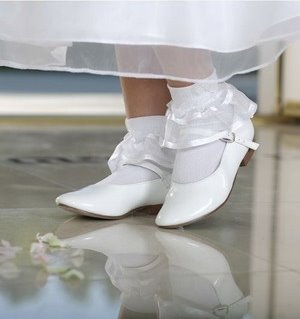
As a child, Easter meant a new dress and a fine white purse to match my shiny, new, white shoes which I would wear only to church. It meant traveling across town to share dinner with a family of friends from Chicago, who marked the occasion by molding butter into the shapes of lambs and crosses. Our Easter baskets were always grandiose things; large and round they were stuffed with chocolate, before being wrapped in pastel-colored cellophane, cinched with matching ribbon. Easter morning found four of them, arranged in a grand display upon the kitchen table. The trick was to slide your hand into the flap created by the cellophane in order to pilfer a peep before Mom and Dad woke up.

By the time my children were born, Easter dinner had become a strictly family affair. Easter egg hunts were added to the celebration, meaning my children usually had at least two opportunities to load their baskets. The hunt at my parent’s house was always conducted outside, while I occasionally chose to nestle my children’s loot against window sills, behind curtains, under a lamp, or between two books on a bookshelf. The children seemed to prefer the indoor hunts. I like to think they enjoyed the intimacy.

“What are we going to do today, Mom?” Shane’s question left me wanting. We settled on a trip to the park. He and his Dad will play pitch and catch, while I walk the dog around the track. It should be a good day for it. The weather is beautiful. Later, we’ll cook out.

But I can’t help wishing there was something more…

© Copyright 2007-2009 Stacye Carroll All Rights Reserved
Fashionistabunny

My father attended church with us only twice a year, Christmas and Easter. Mother went more regularly until we were older, at which point the car barely came to a full stop before she started shooing us out the door.

“Meet me right here when church is over!”, she shouted as she accelerated past the crosswalk.

There was always a line of people waiting to enter the sanctuary. Dark-suited, older, white males stood solemnly, just outside two sets of double doors, holding small stacks of church bulletins which I had came to think of as my ticket; Admit One. As my sisters and I waited our turn in line, I studied the ushers. They always put me more in mind of sentries guarding a castle than greeters for the “House of God”.

Standing in that line was a bit like walking downtown sidewalks surrounded by sparkling skyscrapers of varying heights. The air lay thick with a potpourri of scents spritzed from cut-glass atomizers, as I shuffled my feet inside black patent leather. Women, who had soldiered through the previous week in their uniform of polyester pants and rubber-soled, terry-cloth scuffs, now fanned their tails like so many peacocks in designer finery. I studied the mink stole draping the shoulders of the woman in front of me, appreciating the varying hues of brown, gold, and black while following the seams connecting the pelts with my eyes.

“Love the dress!” The furred woman spoke to another woman just to the right of us whose eyes sparkled above her rouged cheeks before looking down at her dress, as though she had forgotten what she was wearing.

“Oh, thank you!” Her hands went to her bare arms and I felt her self-consciousness. “What a gorgeous fur! Is it mink?”, she asked through strained painted lips.

“Yes, Gordon brought it back from his last trip to New York.” Red-tipped nails caressed both arms. “I wore it today since it might be my last opportunity before summer.”

“Gayle! Is that a new ring?” Another feminine voice swiveled my head to the left, just as the older woman next to me retrieved her hand from its spot under her husband’s arm.

“Yes! Robert gave it to me for Christmas.”, she said, flashing a smile at her benefactor, who answered with one of his own. She raised her hand towards her friend who turned it this way and that, in appreciation.

“Wow! Pretty snazzy, Robert. Gayle must have been a good girl!” Gayle lost her footing in laughter, bringing the tip of her pointed-toed pump firmly against my Mary Jane. I turned swiftly so as not to be caught staring. By the time I reached the sentries, the aisle separating the pews looked more like a catwalk.

If most Sundays produced a fashion show, Easter Sunday served as “Fashion Week”. No one was immune. Men bought new suits, and corsages for their ladies. Women scanned racks for weeks, in search of the perfect dress and dyed new pumps to match, before retrieving their jewelry from velvet beds inside safe deposit boxes.

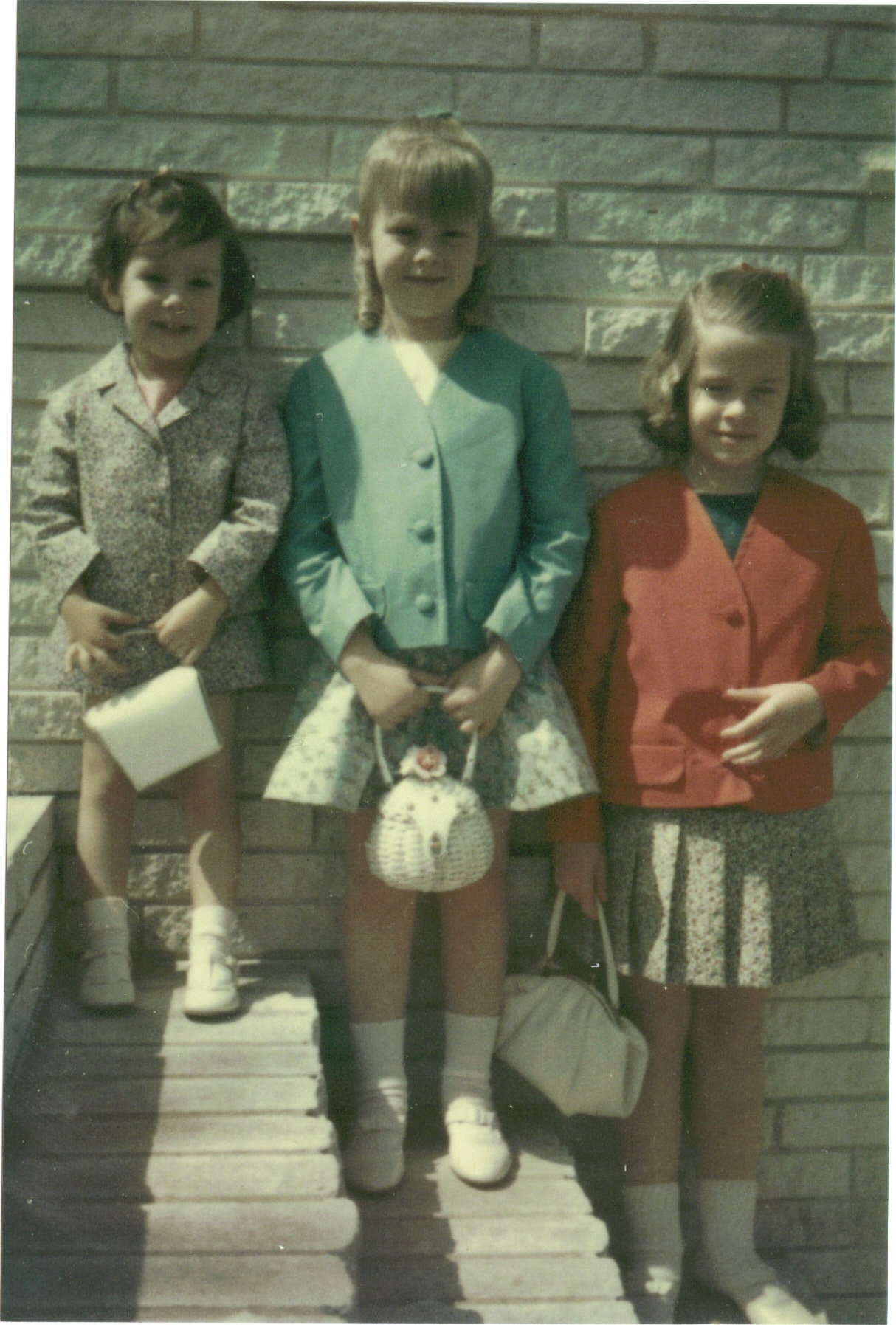
Girls were taken shopping for Easter dresses. Most girls. My sisters and I were taken instead to “Cloth World”, where we were encouraged to choose from one of several fabrics from which my mother would fashion a suit. The fabrics were coordinated so that each girl would wear a solid and a print, and the style would vary, if only slightly.

My mother was an excellent seamstress, having culled the talent from her mother who made her living as a tailor in an exclusive men’s clothing store. She made most of our clothes and some of her own. One of my fondest memories involves a church fashion show, for which my mother created four identical white dresses; one for her, and one for each of us. Walking as ducks in a row, we took the stage together the afternoon of the show. I don’t remember who actually won, and it never was important. In my mind, my mother stole the show.

As a child, I never appreciated our carefully coordinated Easter suits. I felt dowdy and out of fashion. I watched other girls swish by in taffeta, and lace and wished the sewing machine had never been made available for purchase by the public. And, I resented my mother for not understanding.

Several years ago my grandmother died, leaving behind boxes and boxes of photographs my mother had sent her in celebration of our childhood. My youngest sister, who had been my grandmother’s primary caretaker, arranged a luncheon at which she invited us to open the boxes and take the pictures that meant the most to us. As we leafed through the photographs, there were countless images of my sisters and me, usually backed up against a wall and standing in descending order, wearing our mother’s handiwork. When I searched my mind today, for Easter memories, these pictures were the first thing that came to mind.

We miss so much when we are children, when our minds are not yet fully formed and ready to understand the importance of things. As I study the photographs now, I see more than meticulous construction and careful coordination. Forty-plus years later, I see time, and effort, and sacrifice, and love. And, in her sharing of the photographs, I interpret pride; pride in her children, yes, and something more. By sending these photographs to her mother she shared, and appreciated, her legacy.

I hope I said it then. I wish she could hear it now.

Thanks, Mom.

© Copyright 2007-2009 Stacye Carroll All Rights Reserved

“Worry Beads”


As a civil engineer working with a large real estate firm, my father was part of the boom that built Atlanta during the 1960’s. It was in this way we came to know the Kwechs, a family of Chicagoan transplants. They talked funny, slathered both sides of their sandwiches with butter instead of mayonnaise, and ate pickled fruit. They were also Catholic, which was my mother’s way of explaining Mrs. Kwech’s habit of pinning a handkerchief into her hair before entering a church.

As we sat down to a Thanksgiving dinner featuring butter molded into the shape of a lamb alongside pickled peaches, all five Kwechs made a mysterious hand-motion after “the blessing”. Fascinated, I studied the motion and practiced it; thinking it “neat”, until my mother reprimanded me. This was the first time I heard the word “sacrilegious”.

Of course, my mother’s horror only served to accentuate the exotic nature of this mysterious faith. Obviously, the Catholic Church was much more holy than the garden-variety, Southern Methodist church I’d been brought up in.

I am a Jack-of-all-churches, and master of none. I have studied most of the major religions, and many of the lesser known. Faith, as a practice, fascinates me. So it is, that almost forty years later, I understand that much of the mystery of the Catholic faith isn’t so much a matter of secrecy as it is ritual. Still, compared to Methodism, one of the least imaginative religions ever practiced, Catholicism piqued my interest.

It’s aura lies in its accoutrement; priests in fine robes with satin sashes and impressive head-gear, an assortment of ranked deities, confessionals, and, of course, the rosary.

The first rosary I ever saw was made of rose quartz. I remember thinking it beautiful. Respecting my mother’s admonition, I never considered I could own one until learning that Catholic’s don’t own the patent on the rosary. It seems that this, like so many Protestant traditions, is a practice borrowed from a much older religion.

Buddhists, too, worry rosaries, or malas, during prayer. Traditionally consisting of one hundred and eight beads, a mala is used to keep count while reciting a mantra in meditation. Elizabeth Gilbert elaborated on this tradition, beautifully, in her book “Eat, Pray, Love”. In the book, she points out the symbolism of the number three, inherent in the Buddhist mala. She refers to the number of beads, one hundred and eight, as the perfect number because, while being divisible by three, its individual numbers add up to nine, which, when perfectly divided, also amounts to three, a number of importance in many religions; as in Father, Son, and Holy Ghost.

After reading, and being inspired by, Ms. Gilbert’s book, I ordered and received a Tibetan mala. One hundred and eight, perfectly symmetrical, wooden beads line up along a piece of ordinary twine that, purportedly, has been blessed by one or more Tibetan monks. The beads came protected by a tiny satin, hand-embroidered purse, and they reside within the confines of my over-sized, designer hand-bag.

Today, after receiving several prayer requests from an assortment of friends, residing in a variety of locales across the globe, I retrieved the beads. They rode in my pant’s pocket for most of the day, and now, are secreted against my chest.

Oils, from my hands, lend a new-found gleam to their wooden faces, as my touch reminds me of their purpose, and I pray…

© Copyright 2007-2009 Stacye Carroll All Rights Reserved

“Kirkin’ of the Tartans”


Joy was hard to find amongst the throng of worshipers gathered in the narthex of the church. Standing at 4’11”, in her sensible shoes, and colorful tartan skirt, her painted lips broke into a smile as we rounded the pair of taller men blocking our view. Her arms flew wide in my son’s direction, and he fell into them, as expected. As he pulled away, she retained her hold on his arms, looking him almost eye-to-eye, and exclaimed her delight at seeing him. Turning towards me, she fussed with the vest she’d squeezed beneath her jacket as I complimented her skirt.

She’d seen the pastor’s wife, so she was relatively sure the pastor had arrived as well, but she hadn’t seen the bagpiper. We discussed seating. She hoped it would be alright if we sat near the front. “I can’t sit too far back. It’s hard to hear…”

Three rows from the front, she sidled into a pew, allowing just enough space for our three bodies. Joy likes to touch. I could smell her perfume.

She’d been to the opera since I’d seen her. Rossini was one of her favorite composers, but she’d not seen this performance before. She described it as beautiful, light, and airy. She’d liked it very much.

The pews around us filled as I refreshed my memory of the sanctuary. Fashioned from gracious blonde wood, the ceiling arched high to accommodate and enhance the majesty of organ music, and the builders had preferred graceful curves to corners, giving the room a fluid feel. There was little decoration, save for a table on the rising in front of us, holding a single round of bread and a silver goblet. Behind the table, a three-piece band readied itself for the service, opposite a large, tartan-draped pulpit.

I sat, appreciating the warm simplicity of my surroundings, as my son surveyed the crowd of strangers. I wondered what he was learning. I complied with Joy’s request for a stick of gum.

And the music began…very softly at first, as though far away; a single bagpipe playing a familiar refrain. Placing my hand on his leg, I directed my son’s attention, and we turned to look behind us.

The piper was a sturdily built, older woman dressed in traditional Scottish garb. Heavy, utilitarian boots covered thick woolen socks that met her kilt, the plaid of which was repeated in the sash that partially covered her black woolen jacket. Her reddened cheeks alternately expanded and deflated as she sucked for air between blows, and I was immediately struck by her effort.

Behind her, a stately procession of tartans flowed in on tall poles carried by practiced, stern-faced parishioners. Each pole featured a symbol, and the name of a clan, above their corresponding plaid, and, as they passed, the large swatches of colorful material fluttered at us, gracefully. The music resounded against graceful blonde arches above us, and as the procession continued, my eyes filled with its proud beauty.

The musician took her place to one side of the rising as the tartans flowed in and around her, coming to rest at their designated spots along the thoughtfully curved walls, until we were surrounded by ancestral colors, the haunting strains of a lone bagpiper, and synchronicity.

The speaker, an older man of Scottish descent, and one-time pastor of this church, took the podium, proudly wearing the kilt of his clan. He began his address by explaining Jewish tradition, and, at first, I found myself captivated more by his soft, brogue-enlaced speech, than his message. His focus was on the concept, and importance of, “we, first-person plural…”. He credited early Jewish tradition with introducing the concept, and early Presbyterians with embracing it. He related the history of the “Kirkin’ of the Tartans”, and the prohibitions and ensuing violence that his ancestors had survived. As he spoke, I surveyed the proud plaids lining the walls behind him, and I understood.
We rose, as directed, and I added my voice to the others, as we sang “Amazing Grace” to the accompaniment of a single bagpipe….

As a child, I attended church every Sunday. The car rolled to a stop, and my mother unlocked the doors to let us out. As an adult, I attended for many years until politics monopolized our Sunday school lessons, souring me. World history classes, required by my major, officially debunked most of the Bible, assuring me that my soul was, indeed, in my own hands. Since that time, my attendance in church has been sporadic, and usually socially driven.

My choice to attend today was fueled by a desire to provide, for my son, an experience. The emotion I experienced was unexpected. As I sat in the sanctuary, surrounded by parishioners, and tartans, and history, I came to understand why they were there. I felt their belonging.

The bagpipe began to whine again, announcing a reversed procession. The plaids fluttered in the opposite direction, and I watched through tear-filled eyes. The music faded as the last tartan passed, before growing stronger again, causing me to turn, again, towards the front of the church.

She stood, singularly; framed by double doors. Sunlight rained upon her and the unlikely instrument, and after several minutes, the music continued as she turned, proudly, and walked away.

© Copyright 2007-2008 Stacye Carroll

An Intangible Difference


“No other national election has evoked this kind of emotion.”
As a form of explanation, in the heat of the moment, during a discussion of politics, these words rose to the surface, and sat on my tongue, while I considered their veracity. My mind ticked through previous elections. Images grossly akin to Halloween masks, strolled across my mind’s eye; Reagan, Carter, Ford, Clinton, Bush I and II, and I realized I had felt passion for my candidate during each of these contests, as well. The words remain unsaid. And, still, I consider them…and have come believe the words to be true in an intangibly unsettling way.

In years past, my choice of candidate was usually accompanied by a sure feeling of being “right”. As I considered the men running for President, the decision was a simple one, based on my beliefs and life experience.

“Do you want what’s hiding behind curtain “A” or curtain “B”?” Monty Hall’s face leered under a battered fedora as he spun a shiny black cane.

“Curtain “A”!” My voice rang true with the force of my convictions.

“Is that your final answer?” The question came in the form of endless, expensively produced commercials touting the merits of the one not chosen.

“Yes! That is my final answer!” And it was.

This time around, when asked the question, I find my voice wavering as my eyes search a distant point in the room, and my chest fills with a need for hope. And, therein, lies the difference.

The need for hope; not a full-blown, fist-clenching, flag-waving hope, but a need for hope. A look out the yawning door of an airplane, just before the jump, with the sincere desire that the parachute will function when called upon. That first tentative, pitch-black step away from the side of the bed towards the spot on the carpet where the dog might be sleeping. The catch of breath, when the numbers are called, as the ticket shakes inside a needy hand. The look on the face of one beaten down, afraid to trust an outstretched hand.

As my octogenarian friend frequently laments, “I’ve never seen things this bad.”, I realize it’s no wonder so many of us are uncertain. Nothing in our life experience has prepared us for our current condition, and our beliefs have been challenged by almost a decade of half-truths and outright lies told by those in whom we were forced to rely. We are the ones beaten down, afraid to trust.

On Tuesday, I will stand in line for hours, with hundreds of others in search of hope, and the mere presence of the crowd, as I scan it, will invoke these words:

“In God We Trust.”

© Copyright 2007-2008 Stacye Carroll

For Mattie…


She reads the words, but doesn’t hear them.

Years of indoctrination fail to police her actions, so that her beliefs have form in word, only.

She may seek repentance for her unmitigated attack, ignorant of the original Greek interpretation of the word; “to think differently afterwards”.

She will hope for atonement, based on a set of man-made beliefs.

And, should those beliefs be shown to have merit, she will surely find redemption,

as will we all.

Because, after all, the sacrifice has been made.

© Copyright 2007-2008 Stacye Carroll